
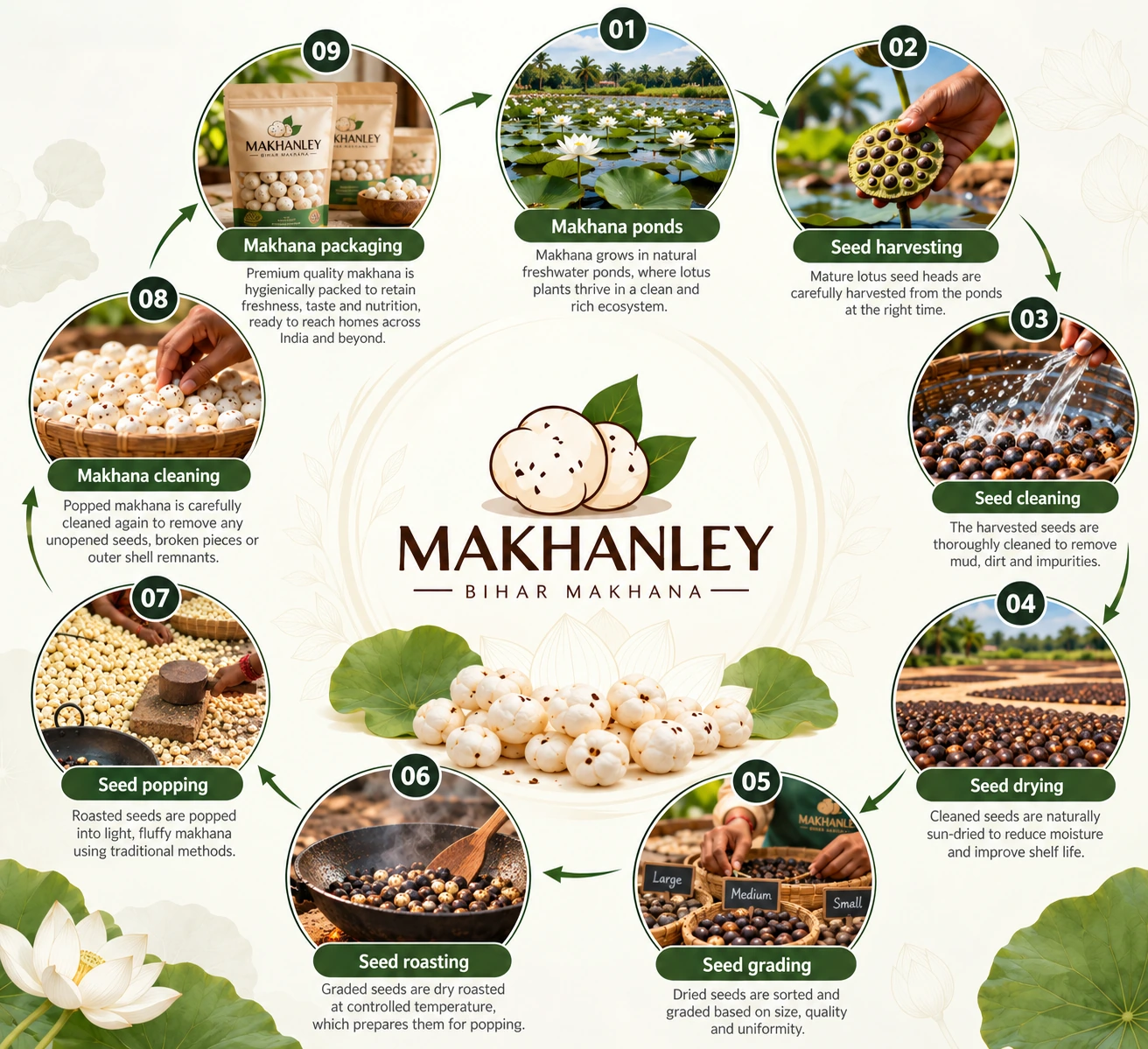
How Makhana Is Made: From Harvest to Processing.

Illustrated Makhanley makhana journey showing ponds, seed harvesting, seed cleaning, seed drying, seed grading, seed roasting, seed popping, popped makhana cleaning and packaging

The process at a glance

Eight broad stages

Each stage prepares the seed or popped kernel for the next step. Select a stage to jump to the detailed explanation.

  1. 01Makhana ponds
  2. 02Seed harvesting
  3. 03Seed cleaning
  4. 04Seed drying
  5. 05Seed grading
  6. 06Seed roasting
  7. 07Seed popping
  8. 08Makhana cleaning

Pond to pop

How makhana is processed, step by step

The first five stages prepare and sort the raw seeds. Heating and popping turn the hard seed into the white kernel, while the final cleaning stage removes loose shell and other residue before the product moves to further sorting or supply.

01 / Makhana ponds

Stage 01

Makhana ponds: where the crop begins

Makhana, also known as fox nut or gorgon nut, comes from the aquatic plant Euryale ferox. In Bihar, it is grown in ponds and other suitable water bodies. Farmers manage the crop in its aquatic environment and prepare for harvesting when the seed-bearing crop matures.

The pond is the starting point, but the work does not end at harvest. The condition of the collected seeds and how they are handled during the next steps affect how consistently they can be dried, heated and popped. Sourcing close to the growing region helps buyers understand where the agricultural part of the supply chain begins.

Why this stage matters: It establishes the origin of the raw material and starts the chain of handling that follows the crop from water to seed processing.

02 / Seed harvesting

Stage 02

Seed harvesting: collecting the raw material

When the crop is ready, farmers collect the mature seed-bearing material from the pond. The usable hard seeds are gathered for post-harvest preparation. Harvesting is physically demanding work and requires practical knowledge of the crop and its growing conditions.

At this point, the material is still raw makhana seed—not the white puff sold as popped makhana. The seed must go through cleaning, drying and further processing before it becomes the expanded edible kernel. Careful collection and handling also help keep the material suitable for the next processing steps.

Why this stage matters: The seeds collected here are the raw input for cleaning, moisture reduction and the later heat-and-pop process.

03 / Seed cleaning

Stage 03

Seed cleaning: removing visible impurities

Freshly collected seeds can carry mud, plant matter and other unwanted material from the pond and harvest. They are cleaned and, where the process requires it, washed to remove visible dirt and residue before drying.

Cleaning at this stage is different from cleaning the white kernels after popping. Here, the aim is to prepare the raw seeds for more even drying and subsequent handling. The precise equipment and handling method can differ between producers, but the objective is straightforward: remove unwanted material before moving the seeds forward.

Why this stage matters: It reduces visible contamination in the raw material and prepares the seeds for drying.

04 / Seed drying

Stage 04

Seed drying: preparing for heat processing

After cleaning, the seeds are spread out and dried to reduce their moisture before the next stages. Traditional operations commonly use sun-drying, although the exact handling conditions vary. Drying is not simply a waiting period: it helps prepare a hard seed for the heat treatment used in popping.

There is no single drying time that applies to every batch. Starting moisture, weather, seed condition and local practice can all affect the process. For that reason, a fixed number of hours or days should not be treated as a universal standard without reference to the specific processing method.

Why this stage matters: Moisture condition influences how the seed responds to later heating, so drying is an important part of preparation.

05 / Seed grading

Stage 05

Seed grading: sorting raw seeds by size

Before roasting, raw seeds can be sifted or sorted into more uniform size groups. Sorting helps processors manage batches more consistently as they move into heat processing. Seed grading in this stage refers to the raw seed—not the white popped kernel.

This distinction matters to buyers: commercial Suta grading generally refers to sizing the popped makhana kernels for trade and product specifications. It is a different step from sorting raw seeds before roasting. A finished lot may be graded again after popping and cleaning, depending on the buyer's requirement.

Why this stage matters: More uniform raw seed batches are easier to handle consistently; final kernel sizing is assessed separately after popping.

06 / Seed roasting

Stage 06

Seed roasting: applying heat before popping

The dried seeds are heated to prepare them for popping. In traditional processing, roasting may be carried out in hot earthen or metal vessels. Temperature, duration and the way the seeds are conditioned between heating steps depend on the method used; traditional hand-processing can include more than one heat-treatment stage.

Roasting here should not be confused with roasting popped makhana as a ready-to-eat snack. In primary processing, heat prepares the hard seed so that the kernel can expand when the shell is broken open. Secondary roasting for a snack happens later, if a finished product requires it.

Why this stage matters: Heat treatment prepares the seed for popping. Timing and handling are important, and there is no single setting that describes every traditional or mechanised process.

07 / Seed popping

Stage 07

Seed popping: revealing the white makhana kernel

In traditional hand-popping, a heat-conditioned seed is struck with a mallet-like tool so its hard outer covering breaks and the inner kernel expands into the familiar white, airy makhana. The processor must judge the condition of the seed and the timing of the impact. This is a skilled operation, not simply a matter of cracking a dry seed.

When the seed is not properly conditioned or the timing and handling are off, the result may be less fully expanded or more broken material. Mechanised systems also exist in the wider industry; the traditional method shown in Makhanley's journey is one established way of producing popped makhana.

Why this stage matters: This is the transformation from hard raw seed to the light, white kernel sold as popped makhana.

08 / Popped makhana cleaning

Stage 08

Makhana cleaning: separating kernels from shell and residue

After popping, the kernels are handled to remove loose shell, fragments and other unwanted residue. This post-popping cleaning step is separate from washing the raw seeds at Stage 3: its focus is the white popped product and the material left around it after the shell has been opened.

Once cleaned, the popped makhana can move into additional sorting, commercial Suta grading, quality checks and packing according to the product and buyer specification. Some lots are supplied as plain popped kernels for further use by a buyer; other orders may involve additional finishing or consumer packaging.

Why this stage matters: It prepares popped kernels for subsequent inspection, sizing and the next step in the supply chain.

After the eight stages

From clean kernels to a buyer-ready lot

The eight-stage journey explains how the hard seed becomes clean popped makhana. Commercial preparation may continue after that point, depending on the buyer's use and specification.

02

Quality inspection

Lot requirements may cover size, colour, moisture, visible impurities, breakage and other buyer-defined acceptance criteria. Exact specifications should be agreed for the lot.

Common questions

Makhana processing explained

Is makhana the same as fox nut?

Makhana is commonly called fox nut or gorgon nut. It is the edible popped seed of the aquatic plant Euryale ferox.

Why does makhana need roasting before popping?

Primary heat treatment prepares the hard seed for popping so the inner kernel can expand when the shell is broken. Traditional and mechanised methods may use different heating and conditioning sequences.

What is the difference between seed grading and Suta grading?

Seed grading at Stage 5 sorts raw seeds before roasting. Suta grading is used in trade to describe the size of popped kernels after processing. They refer to different material at different points in the journey.

Is all makhana flavoured or roasted as a snack?

No. The initial roasting described in this guide is part of producing popped kernels. Additional roasting, flavouring and retail packaging may happen later when a ready-to-eat product is being made.

Do all processors follow exactly the same eight stages?

No. The eight steps on this page are a practical overview of Makhanley's journey. Traditional workflows can include additional heating, conditioning or sorting steps, and mechanised systems may arrange operations differently.

For more technical context, see the Indian Council of Agricultural Research overview of traditional and mechanised makhana popping and the Government of India's overview of makhana processing and value addition.

For wholesalers, manufacturers and brands

Looking for makhana in bulk?

Share your required grade, approximate quantity and destination with Makhanley. The appropriate lot and available specifications can then be discussed for your requirement.

Continue from the production process

Darbhanga processing operation →Bihar collection-centre network →