
Makhanley sourcing focus
North Bihar
Farmer relationships centred on Darbhanga, Purania and Madhubani.
Origin · Cultivation · Sourcing
Bihar sits at the centre of India’s makhana supply chain. Makhanley’s farmer network is primarily in Darbhanga, Purania and Madhubani, with relationships extending into other districts. This guide explains where the crop is grown, how the season shapes supply and what wholesale buyers should check before ordering.
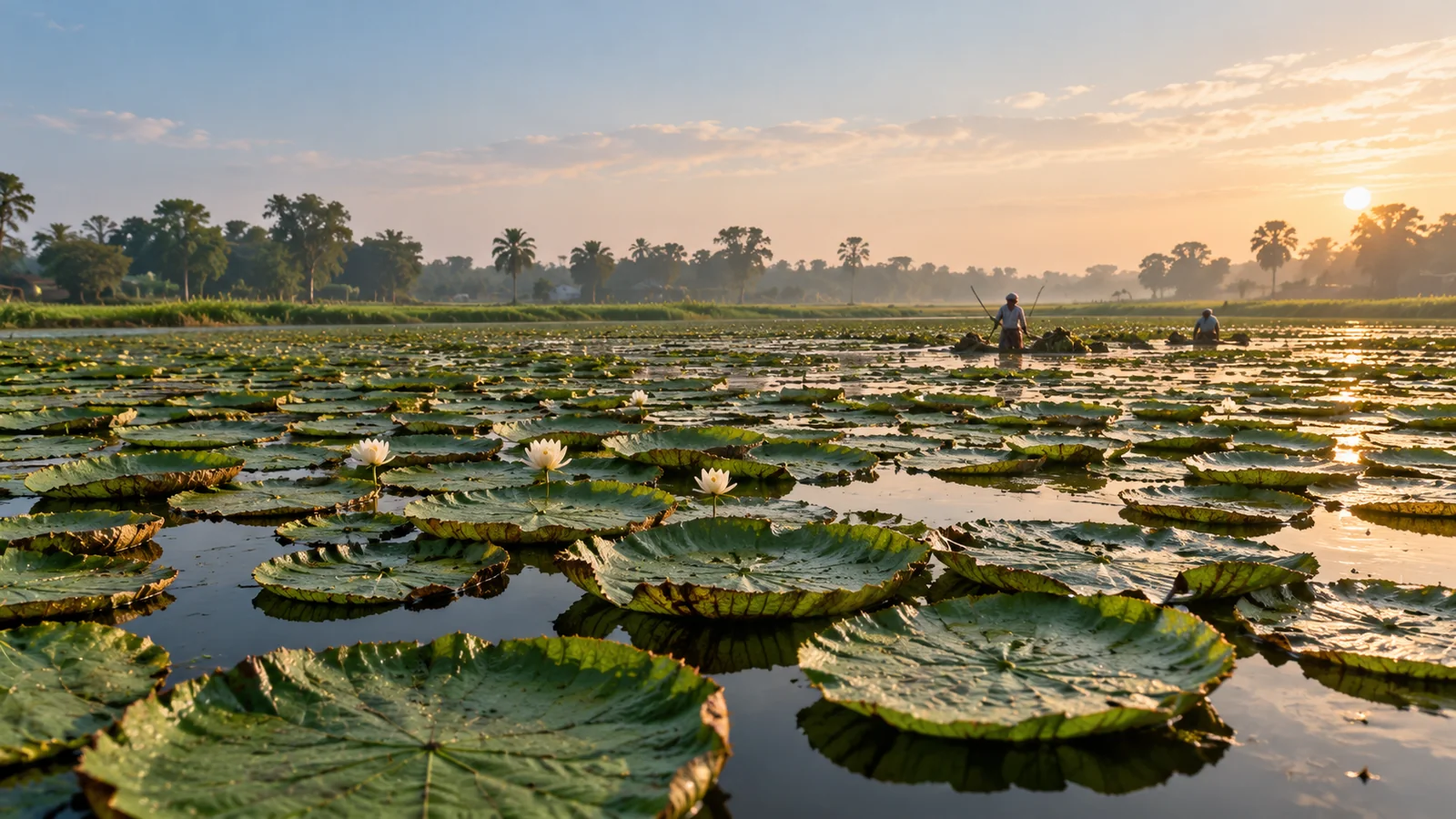
Makhanley sourcing focus
Farmer relationships centred on Darbhanga, Purania and Madhubani.
Indicative harvest period
APEDA’s crop calendar places much of the seed-collection period in late monsoon and early autumn.
Regional identity
A registered Geographical Indication, with official registration recorded in 2022.
The growing belt
Makhana cultivation and trade are concentrated in parts of North Bihar, including the Mithila and Kosi regions. Government agriculture material identifies Darbhanga, Madhubani and Purnia among the state’s traditional production hubs, with other districts contributing to the wider growing belt.
Primary Makhanley network
Darbhanga is a traditional makhana cultivation and trade centre in the Mithila region. It is also Makhanley’s home district, making this one of the main areas in our farmer network and sourcing conversations.
Primary sourcing areaPrimary Makhanley network
Purania is one of Makhanley’s farmer-linked collection-centre locations. It supports procurement and source-to-lot traceability before sourced material moves through the Darbhanga processing operation.
Primary sourcing areaPrimary Makhanley network
Madhubani forms part of the traditional Mithila makhana belt and is recognised in government reporting as both a cultivation area and a trading location for the crop.
Primary sourcing areaOfficial sources also identify districts such as Katihar, Saharsa, Supaul, Madhepura, Araria, Kishanganj and Sitamarhi among the state’s broader cultivation areas. This wider list describes Bihar’s production geography; it should not be read as a claim that every district supplies every Makhanley order.
Why origin matters
Bihar has a long-established combination of suitable growing conditions, farmer knowledge and local collection and trading networks. The sector includes both traditional pond-based cultivation and newer field-based systems; the method used can vary with local land and water conditions.
APEDA’s September 2025 Makhana dashboard describes Bihar as the dominant producing state and documents how production, harvesting and trade are shaped by a seasonal crop cycle. These figures are estimates from a dated dashboard—not a live production count—so current procurement decisions should be based on fresh supplier and lot information.
For a wholesale buyer, regional origin helps explain where supply comes from. It does not by itself guarantee a specific kernel size, moisture level, cleanliness, breakage percentage or lot consistency. Those details should be confirmed against the actual lot and agreed specification.
Read APEDA’s September 2025 Makhana dashboardA seasonal crop
The calendar below summarises the broad cycle described in APEDA’s crop dashboard. Actual dates vary with the cultivation system, water conditions, weather and local farming practices, so treat this as a guide rather than a fixed promise of availability.
Seeds are sown in prepared water bodies or cultivation areas as the crop cycle begins.
Seedlings establish and leaves develop; farmers manage water and field conditions.
Depending on the system, seedlings may be transplanted, followed by flowering and fruit development.
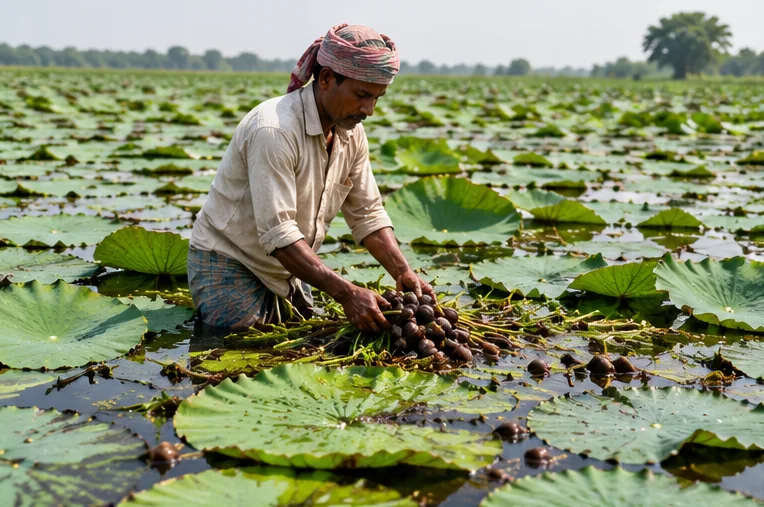
Fruits mature and release seeds underwater, where the seeds collect near the pond or field bed.
Harvesters collect seeds by hand. The work is physically demanding and timing depends on local conditions.
Source: APEDA, Monthly Dashboard — Makhana (Fox-Nut), September 2025. Calendar adapted for general information.
From harvest to buyer
Harvested makhana seeds are not the same as the white popped kernels sold to retailers and food businesses. Post-harvest handling and processing turn the raw seed into the finished kernel that buyers specify by grade and end use.
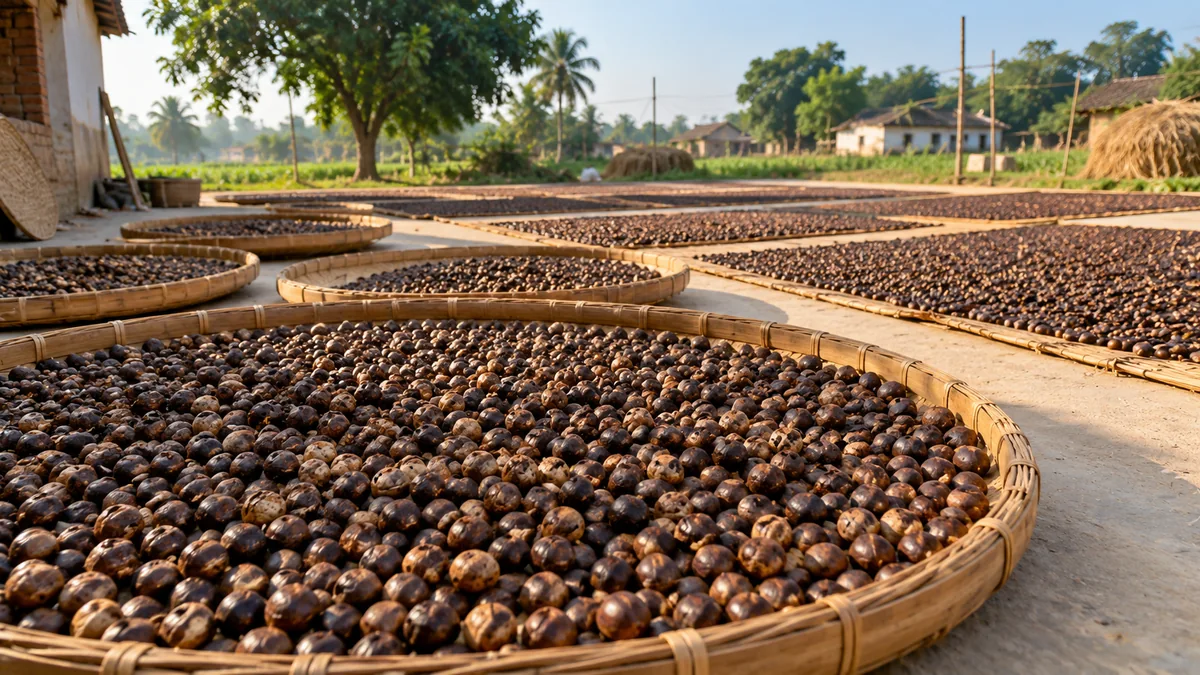
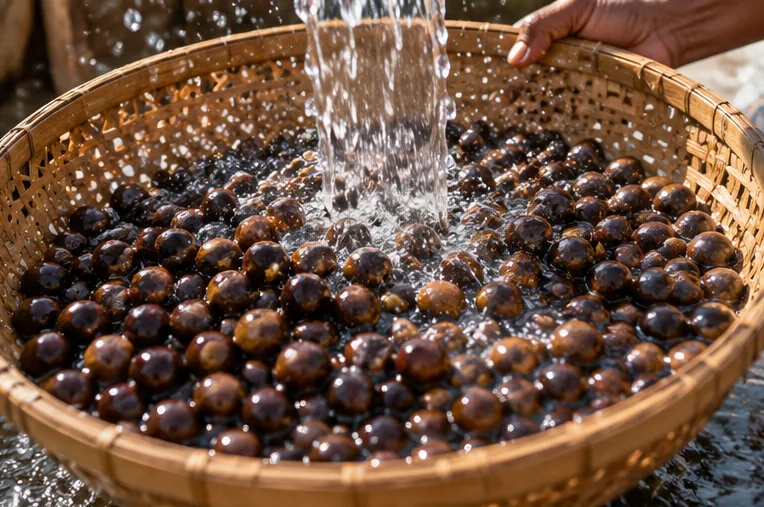
The process images below are illustrative. Actual tools, facilities and handling practices vary by producer and location.
01Mature seeds are collected from the growing area. Timing and collection method depend on conditions at the farm.
 02
Initial cleaning and drying help prepare the seeds for storage and later processing. Buyers should confirm the condition of the lot being offered.
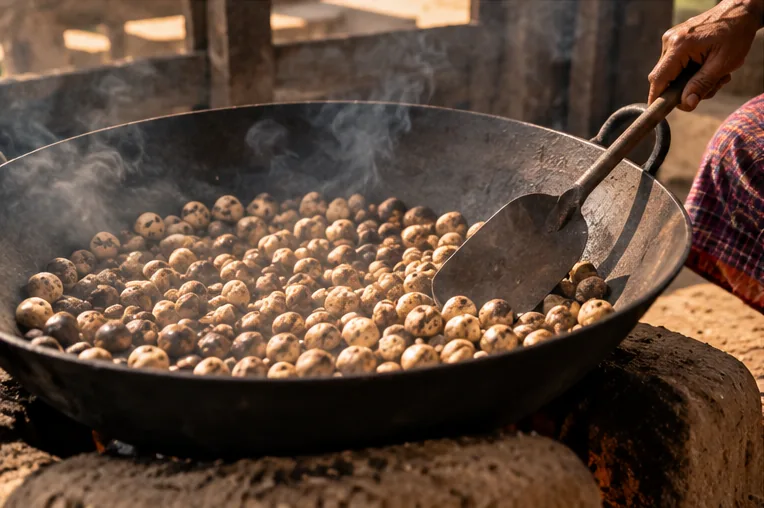 03
Traditional processing applies heat and pressure to pop the hard seeds into the familiar white kernels.
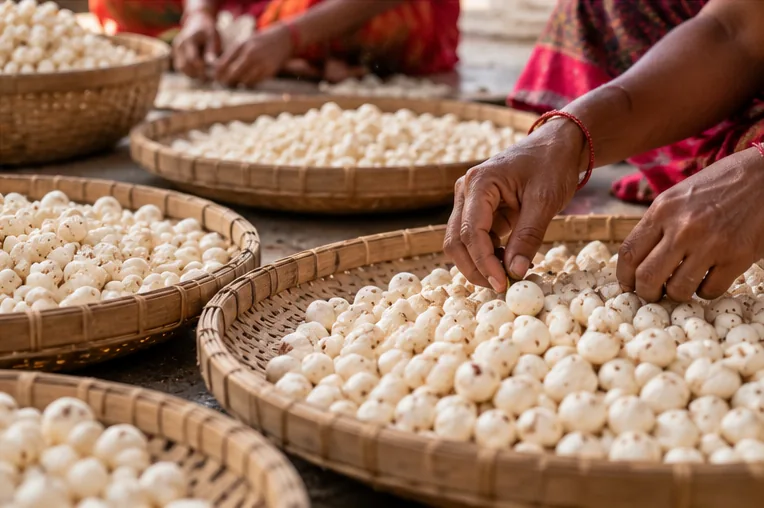 04
Popped kernels are cleaned and sorted. Commercial grade, uniformity and usable yield should be discussed with the supplier.
Want the full process explained stage by stage?
Explore how makhana is madeRegional identity
Mithila Makhana is a registered Geographical Indication (GI). India’s official GI Registry records the name as registered, with a certificate dated 16 August 2022. The registration connects the product name with a recognised geographical origin and its associated identity.
A GI registration is not the same thing as a general food-safety licence, and it should not be taken to mean that every supplier or every product sold as makhana is automatically an authorised GI user. If a purchase specification specifically requires GI-linked product or authorised-user documentation, buyers should request and verify the relevant records before ordering.
Makhanley can discuss the origin and supplier records available for a specific order. If your procurement specification requires proof of GI-authorised-user status or other GI-linked documentation, please tell us before ordering so the relevant documents can be checked for the product or lot being offered.
Verify Mithila Makhana in the official GI RegistryA practical buying checklist
Origin is an important starting point, but a reliable bulk order also needs a clear lot specification. Before confirming a purchase, buyers should discuss the points below with the supplier and agree which details will be checked on the actual lot.
Do not rely on origin or Suta size alone as a substitute for lot inspection. Product suitability depends on the agreed specification and intended use. For current business buying options, start with Makhanley’s bulk supply information and compare the specific 3 Suta, 4/4+ Suta, 5/5+ Suta and 6+ Suta grade pages.
For the policy and industry context, read the National Makhana Board and Bihar industry guide. For commercial orders, see bulk makhana supply.
Common questions
Answers to common questions from buyers researching Bihar makhana and its supply chain.
Government agriculture material identifies Darbhanga, Madhubani, Purnia, Katihar, Saharsa, Supaul, Madhepura, Araria, Kishanganj and Sitamarhi among the important districts. Makhanley’s sourcing network is primarily in Darbhanga, Purania and Madhubani, with relationships in other districts as well.
APEDA’s September 2025 crop calendar places seed collection broadly in August–October. The actual window can vary by area, cultivation system, water conditions and seasonal weather; it should not be treated as a guaranteed availability date for a particular grade or lot.
No. “Mithila Makhana” is a registered Geographical Indication with defined origin-linked identity. Buyers who require GI-specific product or authorised-user documentation should verify the relevant records rather than assume that all makhana from Bihar carries that status.
No. Suta is primarily a size reference. Cleanliness, breakage, uniformity, condition and suitability for the intended application are separate considerations. Compare the lot specification and sample, not just the grade label. See our full Suta grade guide.
Use the WhatsApp us about bulk supply to share your required grade, approximate quantity, product form and delivery destination. Availability, specifications and commercial terms should be confirmed for each order.
Our How Makhana Is Made guide explains the journey from cultivation and harvesting through seed handling, roasting, popping and final cleaning.
From origin to order
Share your target grade, quantity, product form and delivery destination so the right specifications can be discussed before you order. Makhanley also serves international buyers; explore our Makhana export page for export planning information.