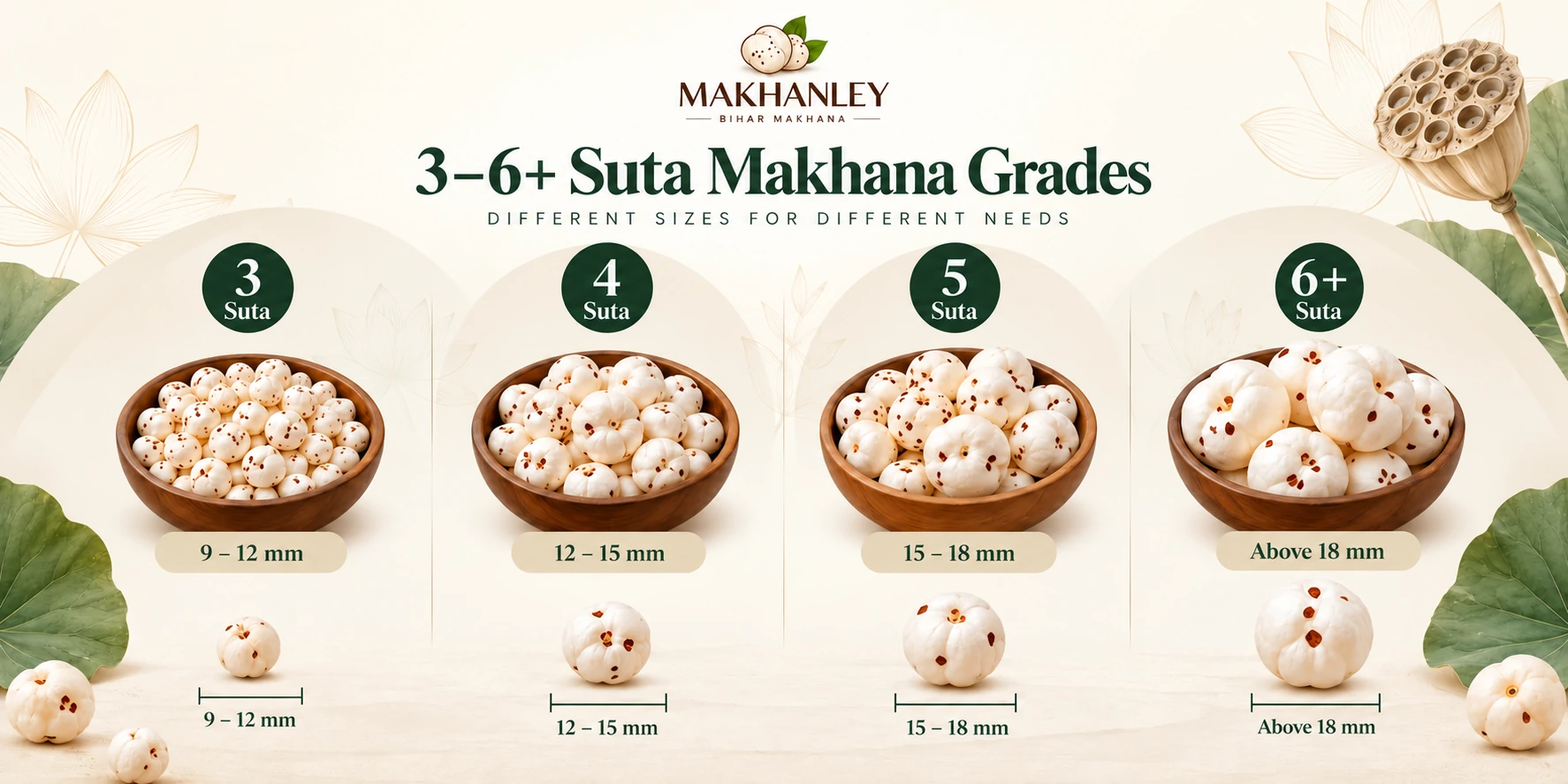
Choosing a makhana grade affects the look of the finished product, how it performs in processing and the economics of a bulk order. Use this guide to compare indicative popped-kernel size bands, understand common trade positioning and prepare a clearer specification for your supplier. For international buyer information, see our Makhana export page.
Visual comparison of common Suta size bands. The millimetre ranges are indicative trade references; confirm the actual lot specification and tolerances before ordering.
At a glance
Makhana grade size chart
In trade, Suta is used as a size reference for popped makhana. Makhanley currently supplies four core commercial grade groups: 3, 4/4+, 5/5+ and 6+ Suta. The chart gives indicative millimetre references for the core 3, 4, 5 and 6+ grades. 4+ sits towards the upper end of the 4 Suta range (12–15 mm), at around 15 mm. 5+ sits towards the upper end of the 5 Suta range (15–18 mm), at around 18 mm. All bands are trade references; confirm actual lot size distribution and acceptance tolerance against the agreed sample and written specification.
Actual size distribution, whole-kernel percentage and lot tolerance
How to interpret 4+ and 5+: APEDA’s October 2025 Makhana dashboard presents whole-number size rows for 4 Suta (12–15 mm), 5 Suta (15–18 mm), 6 Suta (18–21 mm) and 7 Suta (above 21 mm); it does not list 4+ or 5+ as separate rows. A 2025 ISEC policy brief documents finer half-Suta size bands observed in Bihar market practice, but this is research on trade measurement—not a binding grade standard. Makhanley therefore groups upper-end selections within 4/4+ and 5/5+ rather than presenting them as separate core wholesale grades. APEDA Makhana dashboard (Oct 2025) · ISEC Policy Brief 70 (Oct 2025).
These size bands describe Makhanley’s current grade references. They are indicative and should be confirmed against a representative sample and the agreed written specification for each lot.
Understand each grade
Which makhana Suta grade fits your product?
No single grade is best for every business. The right choice depends on your product format, customers, visual expectations, processing method, target cost and the specification your buyers require.
039–12 mm
3 Suta makhana
An extra-small popped-kernel grade for food processing and traditional preparations.
Recorded sample · 3 Suta
3 Suta can be worth evaluating for makhana flour or powder, namkeen, sweets, kheer and other traditional preparations where a smaller kernel suits the process. Test a representative lot for processing yield, breakage and cleanliness.
Confirm before bulk purchase
Does the lot suit your recipe or processing method?
What size variation and breakage limits are acceptable?
Does a trial batch deliver the expected yield and appearance?
A smaller popped-kernel grade often positioned for cost-conscious and flavouring applications.
Recorded sample · 4 Suta
For snack manufacturers or bulk buyers working with seasoning, 4 Suta can be a sensible grade to evaluate when unit economics matter and oversized kernels are not essential. Suitability still depends on how the lot behaves in your roasting, flavouring or packing process.
Confirm before bulk purchase
How much size variation is acceptable?
What limits apply to broken, flattened or damaged pieces?
Does a trial batch deliver the appearance and yield your process needs?
A regular-snacking reference grade for buyers comparing size, presentation and cost.
Recorded sample · 5 Suta
5 Suta is a useful point of comparison for everyday roasted makhana ranges and retail packing concepts. Evaluate it against your required pack appearance, breakage tolerance and processing loss rather than choosing by the grade label alone.
Confirm before bulk purchase
Does the sample represent the expected size distribution?
Will the kernel size suit your retail pack and serving presentation?
Are packaging, quantity and delivery schedules agreed?
A larger-kernel category for buyers prioritising size and presentation.
Recorded sample · 6+ Suta
The 6+ category covers popped kernels above 18 mm, including different sizes within that range. Review the actual size distribution of each lot rather than assuming every kernel is identical, and approve a representative sample against written criteria.
Confirm before bulk purchase
What minimum size and tolerance apply to the lot?
Are whole-kernel percentage and breakage limits defined?
Does the size distribution suit your product and delivery volume?
Use the intended application to shortlist grades, then compare representative samples and written lot specifications before agreeing a price.
01 · Cost and flavouring
Seasoning and value-led snack production
Start by comparing 3 and 4 Suta if your product tolerates smaller kernels. Run a processing trial and compare finished yield, breakage and seasoning performance.
02 · Everyday retail
Regular snack packs and repacking
Compare 4 and 5 Suta against the appearance you want customers to see in the pack. Check consistency across the sample, not just the largest kernels.
03 · Premium presentation
Premium packs and larger-kernel positioning
Evaluate 5 and 6+ Suta when a larger kernel is central to the product presentation. Confirm lot availability, size tolerance and how breakage affects the final pack.
04 · Wholesale distribution
Multiple customer requirements
Choose based on your customers’ specifications and expected demand. A grade mix may be more useful than assuming one Suta size suits every buyer.
These are starting points for comparison, not universal rules. The most suitable grade should be confirmed through the actual product requirements and an agreed sample.
Important distinction
What Suta grading tells you—and what it does not
Suta primarily helps buyers communicate popped-kernel size. It is only one part of a useful bulk makhana specification, so a grade number should not replace a quality check.
A 6+ Suta label does not, by itself, certify moisture, freshness, taste, cleanliness, shelf life or the percentage of whole kernels. These criteria need to be evaluated and agreed separately for the lot and application.
Before approving a lot, check:
✓
Size band and tolerance
Define the desired diameter range and how mixed or borderline sizes will be handled.
✓
Whole and broken kernels
Agree the appearance and breakage requirements relevant to your product.
✓
Moisture and condition
Ask for the lot's applicable moisture details and agree how the lot will be assessed.
✓
Cleanliness and defects
Specify acceptable levels for foreign matter, damaged kernels and other visible defects.
✓
Sample and packing
Approve a representative sample and confirm bag or pack format, net weight and shipment conditions.
Procurement checklist
What to include in a bulk makhana enquiry
A clear first enquiry helps your supplier check the requirement against available lots and provide a more useful response.
1
Grade and size
State the preferred Suta grade and, where important, the indicative millimetre range.
2
Quantity and frequency
Share the approximate kilogram or tonne requirement and whether it is a one-time or recurring order.
3
Use and quality criteria
Explain whether it is for flavouring, retail snack packs, repacking, manufacturing or another application.
4
Sample and tolerance
Agree how the sample represents the shipment and the quality parameters used for acceptance.
5
Packaging and destination
Specify packaging needs, delivery location, target dispatch date and any destination-specific requirements.
6
Commercial expectations
Ask for a quote based on the required grade, available lot, quantity, packing and delivery terms.
Bulk supply from Bihar
Source makhana grades with a clear specification
Makhanley is a Bihar-based makhana manufacturer and supplier serving wholesalers, distributors, snack manufacturers and brands. Our bulk supply process focuses on discussing the required Suta grade, product format, quantity, destination and lot specification before an order is finalised.
Tell us what you need and we can discuss available grades and the details to confirm for your order. Pricing and availability depend on the specific requirement and lot; they should be confirmed directly rather than inferred from grade alone.
Suta is a traditional trade size reference for popped makhana. Makhanley presents four core commercial groups: 3, 4/4+, 5/5+ and 6+ Suta. Some buyers may use 4+ or 5+ informally to describe upper-end selections within the 4 or 5 size bands; confirm the actual lot size distribution and acceptance tolerance for each order.
What is the size of 3 Suta makhana?
Makhanley’s indicative band for 3 Suta is 9–12 mm in popped-kernel diameter. Confirm the actual lot distribution and tolerance before ordering.
What is the size of 4 Suta makhana?
Makhanley’s indicative band for 4 Suta is 12–15 mm in popped-kernel diameter. Actual lots should be checked against the agreed specification.
What is the difference between 5 Suta and 6+ Suta makhana?
Makhanley’s indicative band for 5 Suta is 15–18 mm, while 6+ Suta covers kernels above 18 mm. Confirm the size distribution and tolerance for each lot; size alone does not establish overall quality.
How should I specify 6+ Suta makhana?
State that you need the 6+ category, with an indicative size above 18 mm, and agree the acceptable size distribution, breakage, cleanliness and sample approval criteria in writing.
Which makhana grade is best for wholesale?
There is no universal best grade. The right grade depends on the buyer's end use, target cost, kernel appearance, processing needs and customer specification. Shortlist grades, compare representative samples and record the agreed lot criteria before ordering.
Does a higher Suta grade always mean better quality?
No. A higher Suta grade generally describes a larger size band, not a complete quality rating. Cleanliness, moisture, freshness, breakage, uniformity and product performance should be checked separately.
For wholesalers and business buyers
Need 3, 4/4+, 5/5+ or 6+ Suta makhana in bulk?
Send your preferred grade, quantity, application and delivery destination. We can discuss current availability and the lot specifications to confirm before ordering.