
A product-form checklist for suppliers, traders and exporters
Separate the product description from the tax conclusion
The word “makhana” covers different commercial products. A dried raw seed, a popped kernel, a roasted snack and makhana powder may not share the same tariff description or tax treatment.
The most common mistake is to copy an HSN code or rate from a generic web result without checking the product facts and the exact notification entry. This guide sets out the verified distinctions and the questions to resolve before invoicing.
01 · Start with the product
“Makhana” is a product name, not a complete classification description
Before selecting an HSN or GST rate, describe exactly what is being sold. Dried raw makhana seed, popped makhana, roasted or seasoned makhana, flour and powder are not interchangeable descriptions. Processing, ingredients, preservation, packaging and the condition of the goods may all matter.
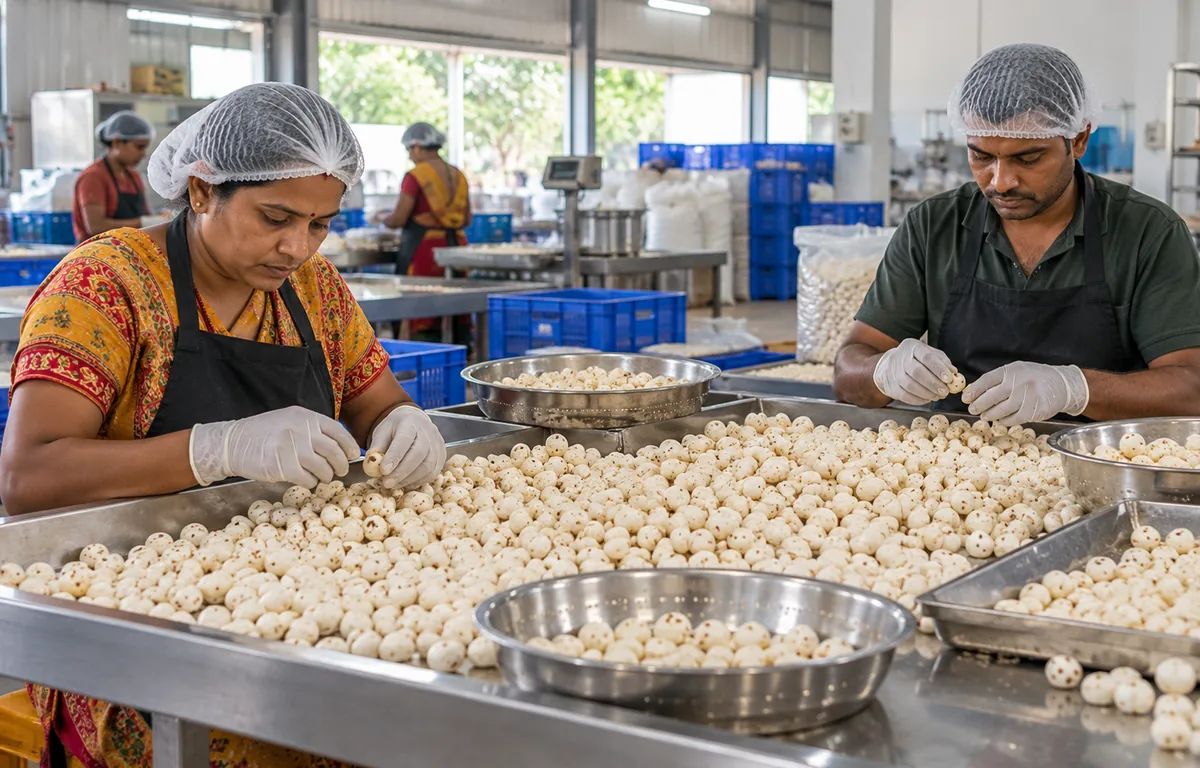
This distinction is important for Makhanley because its core bulk product is plain white popped makhana, while the wider makhana trade also includes dried raw seed, flour, powder and value-added snack products.
02 · Export tariff reference
DGFT ITC (HS) export tariff items for makhana
The DGFT ITC (HS) export schedule separately identifies these makhana product forms under heading 2008:
| Product description | ITC (HS) tariff item | What to verify |
|---|---|---|
| Popped makhana | 20081921 | Confirm that the goods match the tariff description and current schedule. |
| Makhana flour and powder | 20081922 | Confirm processing, composition and product form. |
| Other makhana | 20081929 | Use only when the product description falls within the “other” item. |
The DGFT schedule indicates an export policy status for the listed item. A status shown as Free is not a statement that GST is nil or that the consignment has no other compliance requirements. It is an export-policy classification and must be read with the applicable policy conditions and notifications.
Reference: DGFT Notification No. 44 and ITC (HS) tariff schedule. Check for subsequent amendments before shipment.
03 · GST schedule wording
What the CBIC schedule says about dried makhana
The CBIC GST goods-and-services rate schedule contains a specific entry for dried makhana, whether or not shelled or peeled, under Chapter 08. The schedule describes a 5% rate for the stated category when pre-packaged and labelled, and a nil-rate entry for dried makhana other than pre-packaged and labelled.
This is a description-specific entry. It should not be lifted and applied automatically to popped, roasted, salted, seasoned, flavoured or otherwise prepared makhana without first confirming that the goods fall within that entry and the applicable legal tariff description.
Pre-packaged and labelled
CBIC’s listed dried-makhana entry shows 5% for the described Chapter 08 goods in this category.
Other than pre-packaged and labelled
CBIC’s schedule shows a nil-rate entry for the described dried-makhana category. Do not assume that this applies to popped makhana.
Official source: CBIC GST Goods and Services Rates. Always verify the latest notification, the exact product description and any applicable definitions before issuing an invoice.
04 · Popped makhana
Why the GST rate for popped makhana requires a separate check
The export tariff item for popped makhana is 20081921. That tells an exporter where the product is specifically described in the DGFT ITC (HS) schedule. It does not, by itself, settle the GST rate for every commercial form of popped makhana.
The GST rate must be established by matching the actual product to the applicable GST rate notification and its entry wording. For a product that is plain popped makhana, the classification analysis should record the production process and the state of the goods. If it is roasted, salted, seasoned or flavoured, the additional processing and ingredients should be recorded as well.
Do not assume that the word “dried” in a Chapter 08 entry automatically covers a product that has been popped and is separately described in an export tariff schedule. Equally, do not assume a rate from a generic online HSN search result without checking the current notification text and product facts.
05 · Invoice and export checklist
Information to assemble before fixing the HSN and tax treatment
- Product identity: dried seed, popped kernel, flour/powder, roasted, salted or flavoured product.
- Process flow: cleaning, drying, roasting/popping, seasoning, oil application, coating or any other preparation.
- Ingredients: full ingredient and additive list for a value-added product.
- Product presentation: bulk bag, retail pack, pre-packaged and labelled status, net weight and label particulars.
- Commercial documents: purchase order, product specification, invoice description and any relevant lab report or product sheet.
- GST analysis: tariff item, exact rate notification entry, rate and effective date; retain the legal basis in the tax file.
- Export declaration: verify the ITC (HS) code and current export policy conditions with the customs broker before the shipping bill is filed.
For a live classification issue, keep the invoice, product specification, process note and the relevant notification together. A short written classification memo is more useful than a copied code alone.
06 · Official references
Where to verify the current rules
- CBIC GST Goods and Services Rates — current rate schedule and entry descriptions.
- CBIC Tax Information Portal — GST notifications, amendments and legal material.
- DGFT Notification No. 44 — ITC (HS) tariff items, including the separate makhana product descriptions.
This article is an educational classification reference, not a tax opinion or legal determination for a specific transaction. Rates and tariff schedules can be amended. Obtain product-specific advice before invoicing or filing an export declaration.
Common questions
Frequently asked questions
What is the DGFT ITC (HS) code for popped makhana?
The DGFT ITC (HS) export tariff schedule lists popped makhana under 20081921. The corresponding listed items include 20081922 for makhana flour and powder and 20081929 for other makhana. Verify the current schedule and product description before filing an export declaration.
Is the DGFT export policy status “Free” the same as GST exempt?
No. “Free” in an export policy schedule describes the export policy status for that tariff item, subject to applicable conditions. It does not mean the product is GST-exempt, customs-duty-free in every destination, or exempt from other export requirements.
What GST rate does CBIC list for dried makhana?
The CBIC GST rate schedule has a specific entry for dried makhana under Chapter 08: 5% when pre-packaged and labelled, and nil when other than pre-packaged and labelled. That wording is for the described dried-makhana entry and should not automatically be applied to a different processed or popped product.
Can I use the dried-makhana GST entry for popped makhana?
Do not assume so. Popped makhana has a separate DGFT export tariff item, and the correct GST classification depends on the actual product, process, ingredients, tariff description and current rate notification. Obtain a product-specific classification view before applying a rate.
Does flavoured makhana use the same classification as plain popped makhana?
Not necessarily. Added ingredients, seasoning, preparation, preservation and final product presentation can affect classification. Document the complete formulation and process, then verify the applicable tariff item and GST entry.
Should the same HSN be used for GST invoices and export shipping bills?
The classification systems are related but the reporting context and required tariff detail can differ. Verify the current GST invoice requirement and the full ITC (HS) export declaration code separately with the tax adviser and customs broker.