
A practical inspection guide for wholesale buyers
A Suta grade is only the starting point
Two lots can carry the same Suta grade name and still differ in size distribution, whole-kernel percentage, expansion, colour, cleanliness and moisture. Those differences can affect how the product performs in a snack line, retail pack or food-manufacturing process.
Before you compare quotations, define the quality points that matter for your use. The best time to agree the specification is before approving the sample and confirming the bulk order—not after the goods arrive.
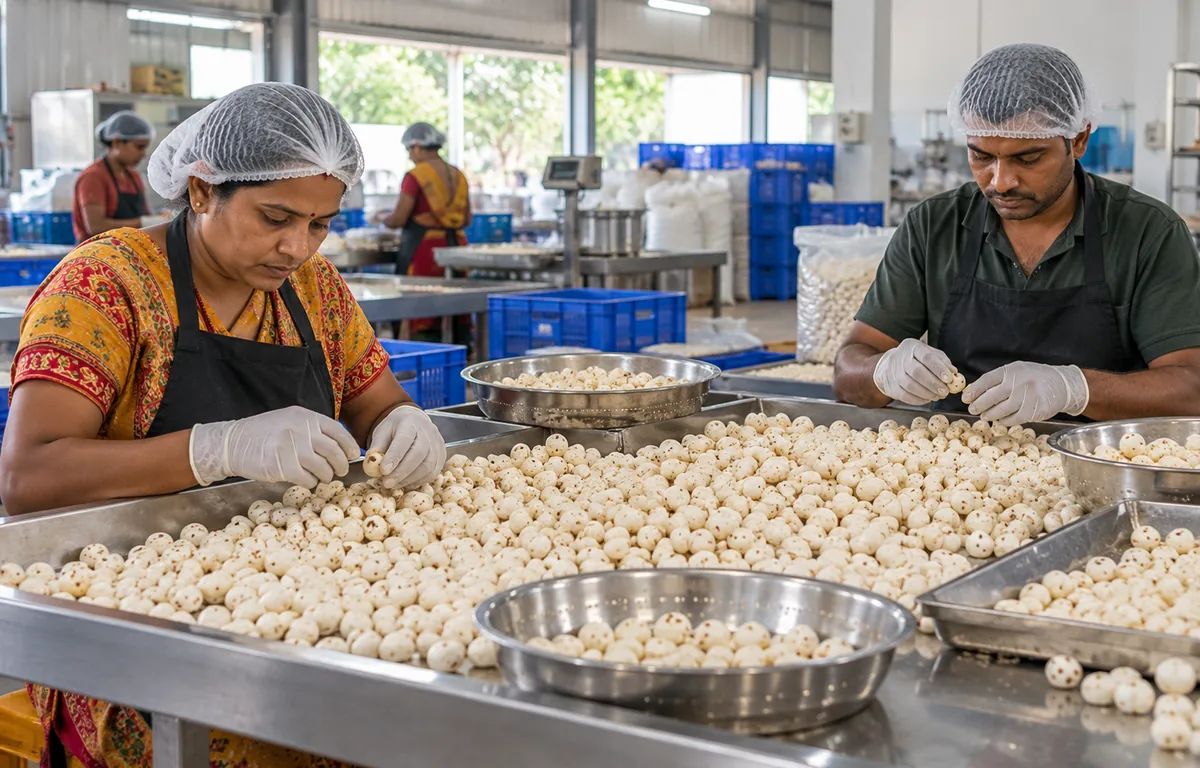
Makhanley processes popped makhana at its Adhloam, Darbhanga facility. The workflow includes cleaning, sieve and automated grading, manual hand-selection, metal detection and dehumidification. Every inventory lot undergoes third-party laboratory testing. The exact commercial acceptance criteria still need to be agreed for the product and lot.
01 · Grade and size
Confirm the Suta grade and the size distribution
Makhanley groups these into 4/4+ Suta (12–15 mm) and 5/5+ Suta (15–18 mm). In trade discussions, 4+ and 5+ may be used informally to describe selections toward the upper end of those respective ranges; they are not treated here as separate core grade groups.
| Commercial selection | Indicative size reference | How to interpret it |
|---|---|---|
| 3 Suta | 9–12 mm | Core 3 Suta reference range. |
| 4/4+ Suta | 12–15 mm | Core 4 Suta size band. An upper-end selection near 15 mm may be described informally as 4+; it remains within this group. |
| 5/5+ Suta | 15–18 mm | Core 5 Suta size band. An upper-end selection near 18 mm may be described informally as 5+; it remains within this group. |
| 6+ Suta | Above 18 mm | Large-kernel commercial category. |
Do not rely on the grade label alone. Confirm how the supplier defines the lot's size distribution, how mixed or borderline kernels are treated, and whether the dimensions are an indicative range or a contractual acceptance requirement. For the full comparison, see the Makhana Suta grade and size guide.
02 · Whole and broken kernels
Agree the acceptable whole-kernel and breakage levels
Whole kernels may be important for premium retail presentation, while a food manufacturer may have a different tolerance depending on whether the makhana will be coated, seasoned, crushed or used as an ingredient. A single breakage limit is not appropriate for every use.
Before purchase, state whether the requirement concerns whole kernels, visibly chipped pieces, crushed material or a combination. Where a percentage matters, agree the sampling approach and the calculation basis in writing.
Do not accept an undefined phrase such as “low breakage” as the only specification. Record the buyer's actual requirement and check the approval sample against it.
03 · Expansion and appearance
Inspect expansion, colour and visible uniformity
Review whether the kernels are properly expanded for the intended product, and whether flattened, irregular or visibly damaged pieces are acceptable. Colour and visual uniformity can also matter to a brand or retailer because customers see the product before they taste it.
Compare the sample under normal lighting and use the same viewing method when the bulk lot is inspected. If the buyer has a specific appearance requirement, describe it with examples or reference photographs instead of relying on broad labels such as “premium white”.
04 · Cleanliness
Check dust, shell fragments and foreign matter
Inspect the product for visible dust, loose shell, plant material and other unwanted foreign matter. Also agree how damaged or discoloured pieces will be treated if they affect the buyer's application.
For bulk orders, specify the buyer's required acceptance limit and the inspection method. Avoid assuming that a visual check alone replaces any laboratory testing, regulatory test or destination-market control required for the particular shipment.
05 · Moisture specification
Keep export and domestic moisture requirements distinct
Moisture can influence crispness, handling and storage. It should be treated as a lot-specific parameter with an agreed test result and method, rather than a general claim used for every product in every market.
Standard export grades
Makhanley's confirmed moisture specification for standard export grades is 5–6%. The applicable export lot is tested and its result should be checked against the lot report and agreed specification.
Domestic bulk lots
Domestic moisture values vary by lot. Do not assume that the export 5–6% specification automatically applies to every domestic lot. Confirm the actual lot result and the agreed requirement before ordering.
Buyer action: Record the target or accepted range, testing method, sample point and the report or evidence required for the particular order. A moisture figure without a linked lot and method is not a complete specification.
06 · Lot testing and records
Ask for testing that relates to the lot being purchased
Makhanley states that every inventory lot undergoes third-party laboratory testing. The tests and report details relevant to an order depend on the product, buyer requirements and destination market.
When a report is required, check that it identifies the lot or sample being discussed, the parameters tested, the laboratory, test date and results. A report for a different batch should not be treated as proof of the quality of the lot being purchased.
For exports, buyers should identify any additional testing or documentation required by the destination market before the order is finalised. Makhanley's export supply page explains the discussion points for international orders.
07 · Sample-to-bulk consistency
Make sure the approved sample and bulk order come from the same lot
A sample is useful only when it represents the product the buyer will receive. A supplier can otherwise send a carefully selected sample from one lot and assemble the bulk order from another, creating a mismatch in size, appearance or breakage.
Makhanley's process: For a specific bulk requirement, the approval sample is drawn from the available lot proposed for that order. Once the buyer approves it, the bulk order is fulfilled from that same approved lot. Makhanley does not send a sample from one lot and fulfil the bulk order from another lot.
Buyers can also order the customisable sample kit online to compare the available commercial grades. The customisable kit is for grade comparison; a lot-specific approval sample is used to approve the particular bulk lot.
Before confirming the order, align the grade, quantity, agreed specification and sample approval. If you need to document these points, use the fillable Makhana Lot Specification & Sample Approval Sheet (PDF).
08 · Packaging and handling
Confirm the bag, seal and outer protection
Plain bulk makhana lots are packed in food-grade inner bags in 10 kg batches, air-sealed and placed inside protective outer sack bags. Confirm that the bag weight, packing configuration and outer protection match the order and onward handling plan.
Makhana can absorb moisture from its surroundings. Keep the product in its original sealed packaging until use and follow the agreed storage and handling conditions. For more detail, see the bulk makhana storage and packaging guide. For custom roasted or flavoured products, packaging format and artwork can be discussed through the private-label manufacturing service.
09 · Record the specification
Use a written lot specification before placing the order
A useful purchase specification should record the points that can affect acceptance, price, testing or delivery. The exact limits are agreed by buyer and supplier for the product and intended use; this checklist does not impose universal tolerances.
- Product: plain popped, roasted/flavoured, or another agreed form.
- Grade and size: selected Suta grade, indicative diameter and treatment of mixed or borderline kernels.
- Whole and broken kernels: agreed percentage or visual acceptance criteria, if relevant.
- Appearance and cleanliness: colour, expansion, visible defects, dust, shell and foreign matter.
- Moisture and testing: lot result, method, sampling point, report and any destination-specific tests.
- Lot approval: sample identification, buyer approval and confirmation that bulk will come from the approved lot.
- Packaging: inner bag material, net weight, air seal, outer sack and required labels.
- Commercial terms: quantity, current quotation, GST/transport treatment, destination and delivery requirements.
Download the fillable lot specification and sample approval sheet to record the buyer's requirement. For current grade-wise indicative prices and MOQ, see the Makhana wholesale price guide and bulk supply details.
Common questions
Makhana quality checks: FAQs
How can I check makhana quality before buying in bulk?
Check the Suta grade and size distribution, whole and broken kernels, expansion, colour, visible cleanliness, moisture, packaging and lot-specific testing. Approve a representative sample and agree the acceptance criteria in writing before confirming the order.
Is Suta grade enough to define makhana quality?
No. Suta is a size reference. It does not by itself define whole-kernel percentage, breakage, appearance, cleanliness, moisture, packaging or test requirements. Those points should be agreed separately for the lot.
What is Makhanley's moisture specification?
For standard export grades, Makhanley's confirmed moisture specification is 5–6%, supported by lot-specific testing. Domestic moisture values vary by lot and should be confirmed from the applicable lot result and agreed specification.
Does Makhanley provide samples before a bulk order?
Yes. Buyers can order the customisable sample kit online. For a specific bulk order, an approval sample is drawn from the available lot proposed for that order.
Will my bulk order come from the same lot as the approved sample?
Yes. Once the specific lot sample is approved, Makhanley fulfils the corresponding bulk order from that same approved lot. It does not use a different lot for the bulk order.
Does every Makhanley lot undergo laboratory testing?
Every inventory lot undergoes third-party laboratory testing. The parameters relevant to a particular buyer or destination should be confirmed for that order, and the buyer can request the applicable lot-specific results.