
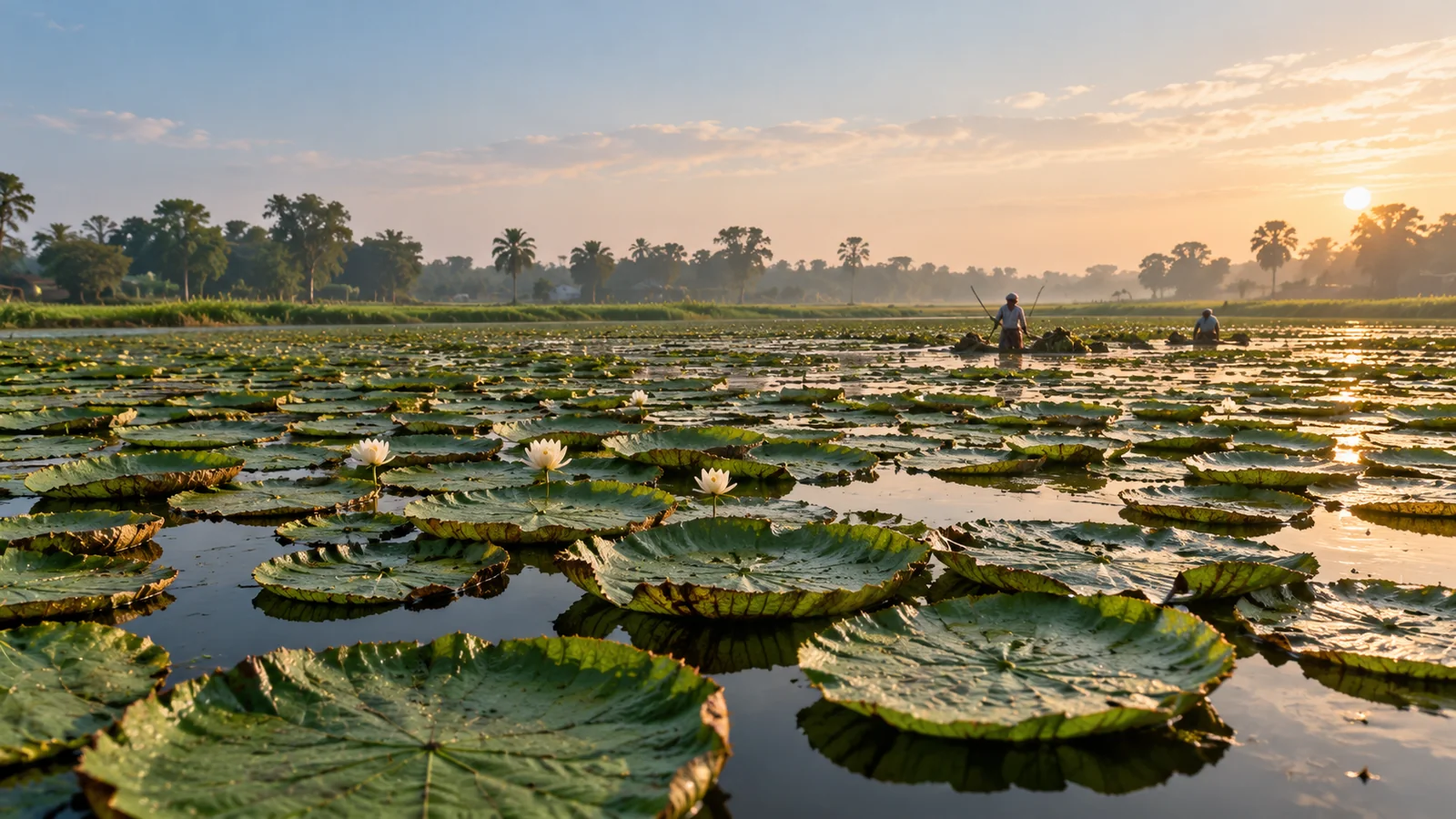
A dated industry briefing based on Government of India and Bihar Department sources
The Board matters because the whole value chain matters
Makhana is not just a crop-sale business. The commercial chain also depends on seed collection, post-harvest handling, popping, grading, quality assurance, packaging, distribution and export access.
The National Makhana Board is intended to coordinate development across that value chain. For businesses, the important question is what is formally notified, what support is currently open, and what can be demonstrated in actual supply operations.
01 · Government initiative
What is the National Makhana Board?
The National Makhana Board is a Government of India initiative intended to strengthen the makhana value chain, from cultivation and post-harvest practices through processing, value addition, branding, marketing and exports. The Government stated that the Board was constituted in Bihar on 14 September 2025.
The Board is relevant to growers, farmer groups, collectors, processors, brand owners and exporters because the sector depends on more than cultivation alone. Seed handling, popping, grading, quality checks, packaging, market access and buyer confidence all influence the value realised from the crop.
This guide summarises publicly announced information available on 12 November 2026. It is an industry reference, not a claim that Makhanley has received government assistance or is affiliated with the Board.
02 · Approved scheme
What has the Government announced under the makhana development scheme?
The Ministry of Agriculture and Farmers Welfare reported that the Central Sector Scheme for Development of Makhana was approved on 14 September 2025 with an outlay of ₹476.03 crore. The stated objective is to strengthen the overall value chain through research and innovation, production, seed distribution, training, skills, post-harvest management, branding, marketing, export promotion and certification-related support.
The Bihar Directorate of Horticulture has also published an online application page for the 2026–27 scheme year. Applicants should read the current official guidelines carefully: eligibility, eligible costs, documents, application periods and assistance limits must be taken from the relevant scheme notice, not inferred from a general announcement.
03 · Bihar supply base
Bihar’s makhana production districts
In its August 2026 statement, the Government cited the 2025–26 second advance estimates and identified Bihar as India’s leading makhana-producing state, with estimated production of 60,000 metric tonnes. The same statement listed these major producing districts:
North and north-east Bihar
Darbhanga, Madhubani, Purnia, Katihar, Saharsa, Supaul, Araria, Madhepura and Sitamarhi.
Research and technology
The ICAR–National Research Centre for Makhana is situated in Darbhanga and works on research, technology development, capacity building and extension.
District-level production estimates and scheme coverage can change between reporting periods. Use the latest official statistical release for planning, and do not treat an advance estimate as a final audited production figure.
For Makhanley’s own sourcing footprint, see the location information for Darbhanga, Purania and Madhubani.
04 · Market development
What the Board could mean for processing and exports
The announced objectives extend beyond growing more seed. For commercial buyers, meaningful progress would include better post-harvest handling, dependable processing capacity, transparent lot specifications, quality testing, packaging, traceability and access to domestic and international markets.
There has already been a visible export milestone. APEDA reported that an 18 MT consignment of GI-tagged Mithila Makhana was exported by sea from Bihar to Australia in August 2026, sourced from farmers in Darbhanga district. That is a specific reported shipment; it should not be interpreted as a guarantee that every producer or supplier has the same export approvals, certification or logistics capability.
Importers should still evaluate each supplier and each lot independently. Confirm the product form, Suta grade, test results, moisture specification, packaging, documentation and destination-market requirements before placing an order. Makhanley’s export supply page and bulk quality checklist explain the buyer-side checks.
05 · Geographical indication
National Makhana Board and the Mithila Makhana GI are different things
The National Makhana Board is a sector-development initiative. The Mithila Makhana Geographical Indication is a separate intellectual-property registration. The official GI registry records Mithila Makhana as a registered GI and maintains a separate authorised-user register.
Do not assume that every business buying or selling makhana from Bihar is automatically an authorised GI user. Businesses should verify the relevant authorised-user requirements, status and permitted use of the GI name or logo with the Registry. The GI registration itself does not prove that a particular supplier is an authorised user.
See the official Mithila Makhana GI record for registration and authorised-user information.
06 · For buyers
What should a wholesale buyer verify before sourcing?
Government schemes and sector growth do not replace ordinary commercial due diligence. A buyer should evaluate the supplier and the proposed lot on their own merits.
- Confirm the supplier’s legal business identity and relevant food-business credentials.
- Specify the required grade and size distribution, rather than relying on a grade name alone.
- Agree whole-kernel, breakage, appearance and cleanliness criteria for the intended application.
- Confirm the moisture result and test report for the actual lot; export and domestic moisture requirements may differ.
- Approve a sample drawn from the same lot proposed for bulk fulfilment.
- Record packing, dispatch location, delivery timeline, quotation validity, GST and transport treatment.
Makhanley’s bulk supply page sets out the current commercial process, while the wholesale price guide shows indicative grade-wise ranges that must be reconfirmed before ordering.
07 · Official references
Government sources and further reading
- Press Information Bureau: Establishment of National Makhana Board — parliamentary reply dated 11 August 2026, published 12 August 2026.
- Bihar Directorate of Horticulture: Makhana Board scheme portal — 2026–27 application information.
- Press Information Bureau / APEDA: sea-route export of GI-tagged Mithila Makhana to Australia — 8 August 2026.
- Intellectual Property India: Mithila Makhana GI registration record.
Government scheme components, application windows, district coverage and market statistics can change. Always consult the current official notice before relying on a scheme or figure.
Common questions
Frequently asked questions
When was the National Makhana Board constituted?
The Government of India stated in an August 2026 parliamentary reply that the National Makhana Board was constituted in Bihar on 14 September 2025.
What is the objective of the National Makhana Board?
The stated objectives include promoting makhana production, processing, value addition, marketing and export promotion, along with research, training and support across the value chain.
What is the approved development scheme outlay?
The Government of India reported an approved Central Sector Scheme for Development of Makhana with an outlay of ₹476.03 crore. Check the official scheme portal for current components, eligibility, application windows and guidelines.
Which districts are major makhana-producing areas in Bihar?
A Government of India statement citing the 2025–26 second advance estimates identifies Katihar, Purnia, Madhubani, Darbhanga, Saharsa, Supaul, Araria, Madhepura and Sitamarhi among the major producing districts.
Does the Board guarantee a support price or purchase of makhana?
Do not assume that it guarantees a procurement price or government purchase. Check current official notifications for any support, market intervention or procurement provision; the Board’s stated objectives alone do not establish such a guarantee.
Does the GI registration mean every Bihar supplier is an authorised user?
No. GI registration of a product and registration of an individual authorised user are distinct matters. A business should verify its own authorised-user status with the Geographical Indications Registry before using GI-authorised-user claims or marks.