Thinking about launching your own makhana brand in the United States?
Perhaps you already sell snacks and want to introduce a new product. Maybe you are an entrepreneur looking for a food product to build a private-label brand around. Or you may be an importer who wants to source traditional Indian makhana and sell it under your own brand in the American market.
Whatever your starting point, launching a packaged food brand involves more than finding a product and designing an attractive pouch. You need the right product, a sourcing partner, suitable packaging, food-safety documentation, a clear landed-cost calculation and a realistic plan for reaching customers.
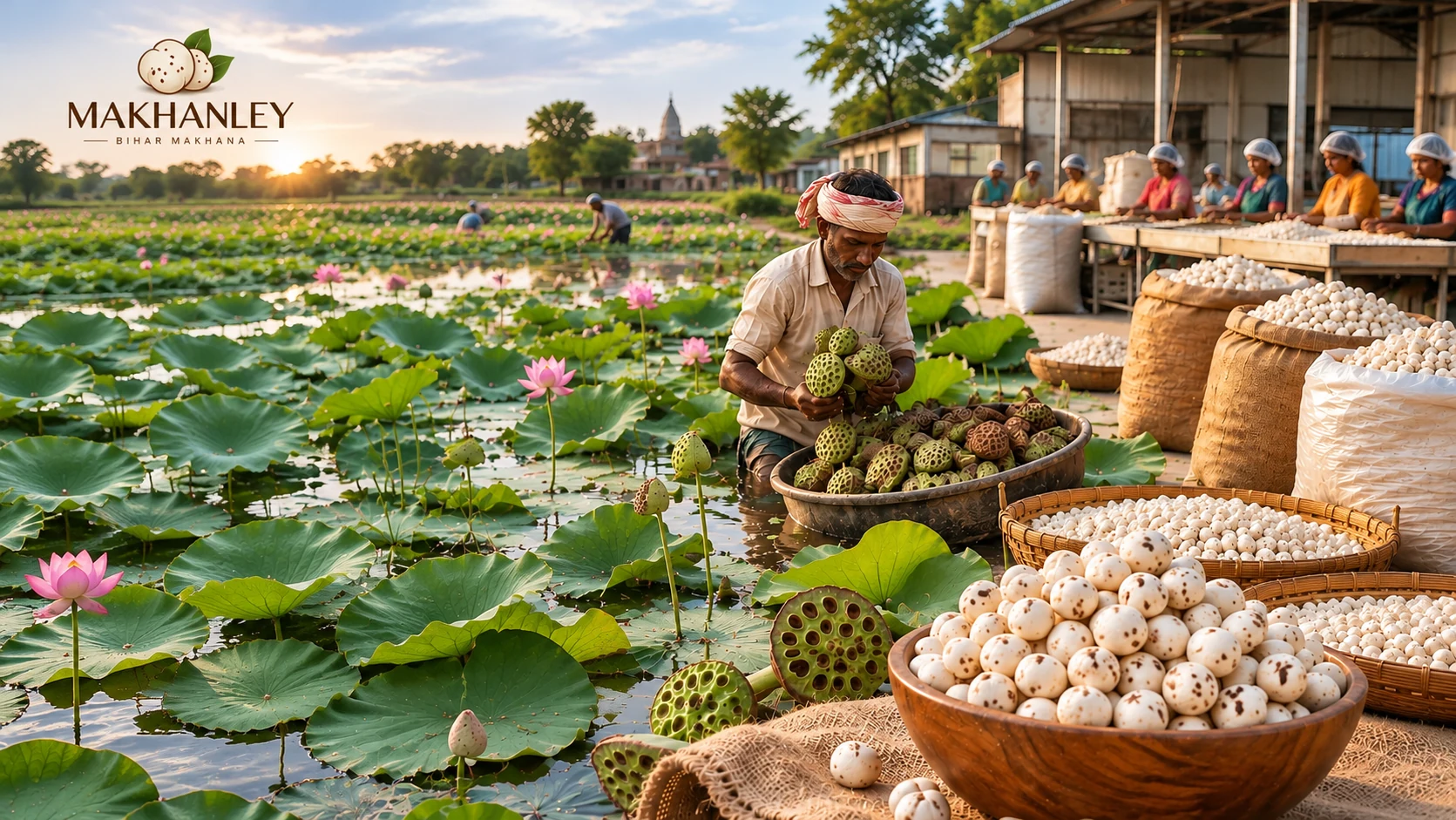
Makhanley is a Bihar-based makhana manufacturer, bulk supplier and exporter located in Adhloam, Darbhanga. We work directly with more than 100 farmers through dedicated collection centres in Darbhanga, Purania and Madhubani. Our own facility handles cleaning, grading, manual hand-selection, metal detection, dehumidification and third-party lot testing. We also roast, flavour and package products for private-label brands, with custom branding and packaging for food businesses.
Know Makhanley and our operations →This guide walks through the steps involved in taking a makhana idea from product selection and samples to US regulatory planning, packaging, marketing and commercial launch. It also explains what Makhanley can supply and which responsibilities remain with the US importer or brand owner.
01 · Market planning
Is there an opportunity to launch a makhana brand in the USA?
Makhana may already be familiar to Indian consumers, but many American shoppers are still learning what fox nuts are and how they are eaten. That creates both an opportunity and a marketing job: your brand has to explain the product clearly and give customers a reason to try it.
Do not build the business plan around a broad claim that “everyone is looking for makhana.” Start by deciding exactly who is most likely to buy your first product.
Indian-American consumers
Start with customers who may already know makhana from Indian households, fasting foods, snacks and grocery shopping. Consider South Asian grocery stores and online Indian food channels.
Mainstream snack customers
Introduce fox nuts as an unfamiliar snack with a clear product description, flavour, serving idea and easy-to-understand packaging. Test the product rather than assuming awareness.
Specialty food retailers
Approach independent snack shops and specialty retailers with samples, wholesale pricing, pack details and a realistic supply plan.
Food manufacturers and distributors
Supply plain popped kernels or agreed finished products to businesses that want a new ingredient or private-label snack in their portfolio.
Research before placing the first large order
- Compare existing fox nut and snack products in US retail and online stores.
- Check pack sizes, flavours, retail prices, customer reviews and product positioning.
- Speak with potential retailers or customers about what they would actually buy.
- Estimate your selling price after landed cost, fulfilment, retailer margin and marketing.
- Choose one clear customer group for the first pilot rather than launching for everyone.
The opportunity is not just to bring an Indian product to the USA. It is to create a product that fits a specific customer, price point and buying occasion.
02 · Origin and heritage
Why Mithila and Bihar matter to your makhana brand
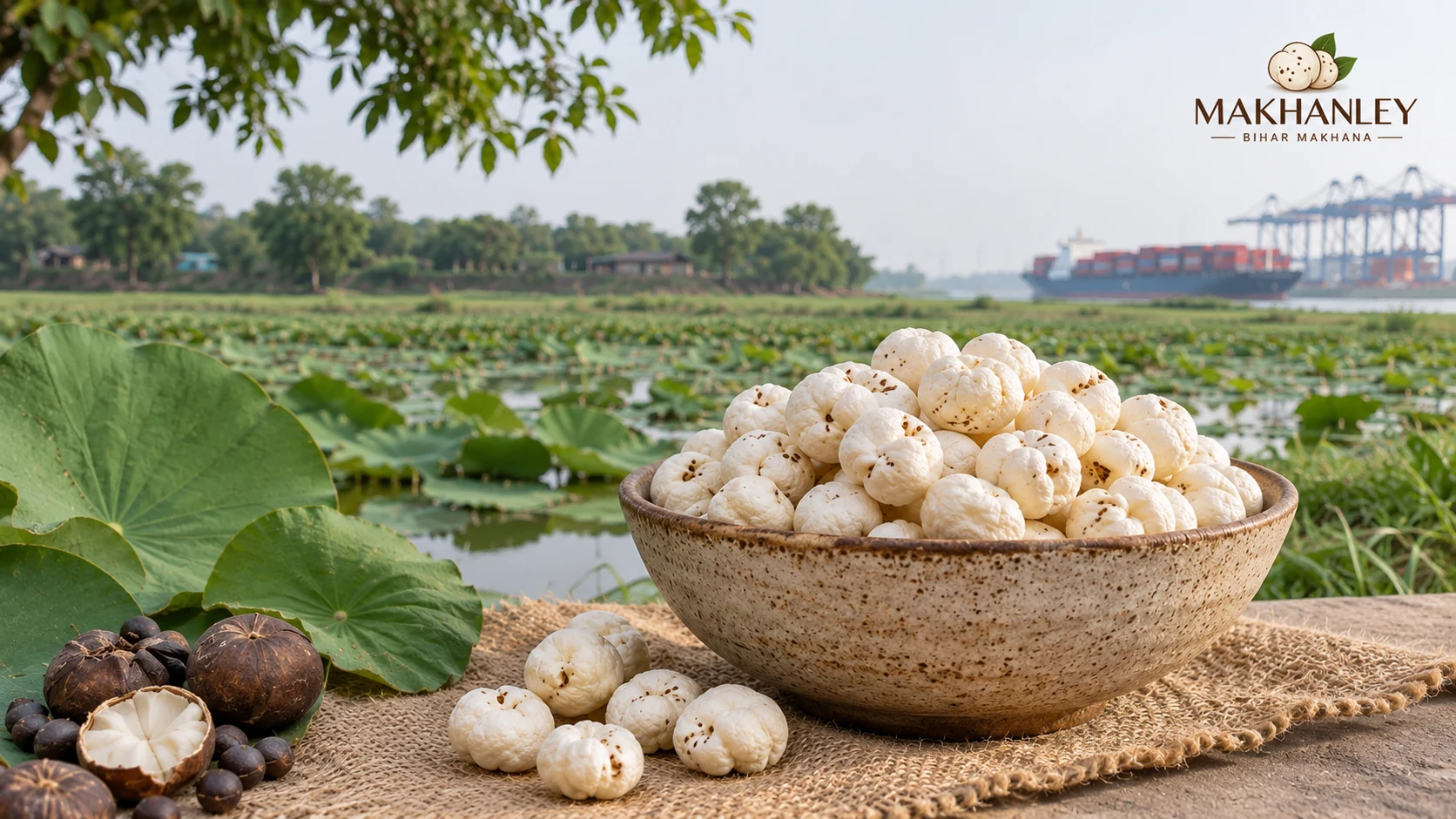
Bihar is India's leading makhana-producing state, and the Mithila region — including Darbhanga and Madhubani — is strongly associated with makhana cultivation and traditional processing. A 2025 APEDA–ICRIER study on India's makhana exports examines the production and value chain and draws on field visits to Darbhanga and Madhubani. The product is made from the seeds of the aquatic plant Euryale ferox, which are harvested, dried, processed and popped into the white kernels familiar to consumers. Read the APEDA–ICRIER makhana export study →
What is the Mithila Makhana GI tag?
Mithila Makhana is registered as a Geographical Indication (GI) in India. The official GI Registry records certificate number 421, dated 16 August 2022, with Bihar shown as the registered geographical area. The GI recognises the origin-linked identity and reputation of the registered product.
Check Mithila Makhana in the official Indian GI Registry →
Can every Bihar-based business use the GI name and logo?
Do not assume that a Bihar address alone gives every business automatic permission to use the official GI logo or make a GI-authorised-user claim. Under India's Geographical Indications of Goods (Registration and Protection) Act, a producer may apply to be entered as an authorised user, and the Act gives the authorised user the exclusive right to use the registered GI for the registered goods, subject to the registration's conditions.
For a US brand, this means you should verify the actual source of the product, the registered GI specification, the producer's authorised-user status or other applicable rights-holder documentation, and the permitted way to display the name or logo. Do not print an official GI emblem on packaging simply because the product was purchased in Bihar.
The United States has its own framework for protecting geographical indications, commonly through certification marks, collective marks and trademark law. Indian GI registration does not automatically create a US trademark registration or mean that every US brand can use the GI logo. Have the proposed name, badge and packaging claim reviewed before printing.
Use the real origin story — the region, farmers, traditional processing and actual sourcing route — rather than unsupported claims. Learn more about makhana growing regions and sourcing in Bihar and Makhanley's operations.
03 · Product strategy
Choose the makhana product you want to sell
Before you ask for a quotation, decide whether you want to sell plain popped makhana, a ready-to-eat roasted snack or a flavoured product under your own brand. The product format affects the ingredients, processing, packaging, testing, labelling and cost.
Plain white popped makhana
This is the core bulk product for wholesalers, distributors, snack manufacturers and brands that want to season or pack the product themselves. Makhanley supplies plain white popped makhana in its commercial 3, 4/4+, 5/5+ and 6+ Suta grades. Buyers can specify the grade, quantity and packing requirements.
Roasted makhana
Roasted makhana is a finished snack product that can be packed for retail or private-label sale. It is suitable for brands that want a ready-to-eat format rather than asking customers to roast the product at home.
Flavoured makhana
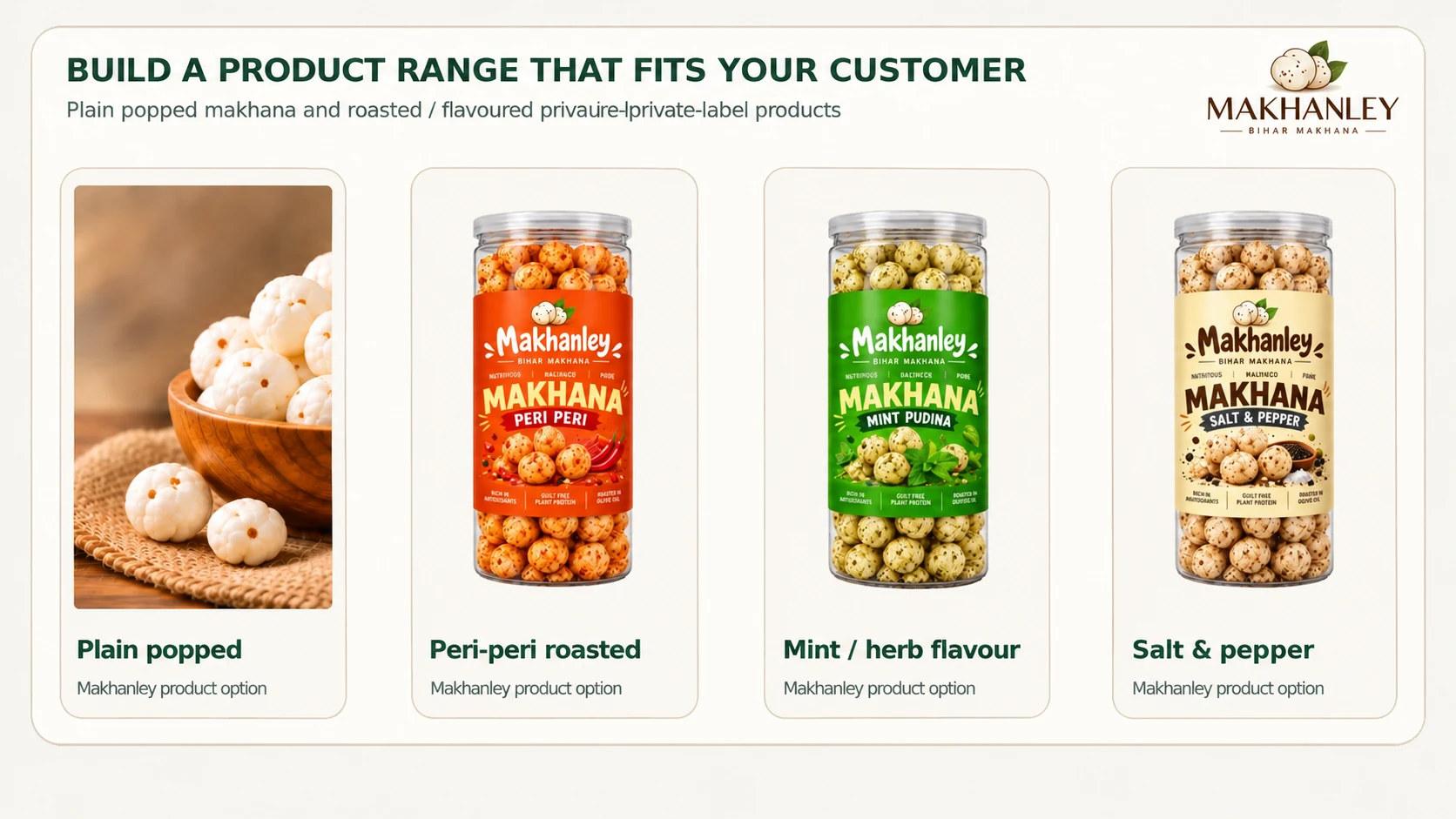
Flavoured makhana gives a brand more than one taste option. Makhanley supplies roasted and flavoured makhana as part of its regular private-label offering. Product concepts can include familiar savoury profiles such as peri-peri, mint or pudina, and salt-and-pepper, as well as other agreed flavour directions. The final ingredients, recipe, allergen profile and product specification must be confirmed for each SKU.
Private-label makhana
Private labelling means the product is supplied for sale under your brand. Makhanley provides private-label supply for roasted and flavoured makhana, including custom branding and packaging discussions. You can develop the product range, pack size and visual identity while working with an Indian manufacturer for sourcing, processing and packing.
For manufacturing, flavour development and pack-format options, see Makhanley’s private-label makhana manufacturing service.
Before production, agree on the flavour, ingredient list, pack size, artwork, label details, order quantity, quality specification and dispatch arrangements. Your US label must be reviewed against the actual formulation and current requirements.
What about raw seeds, flakes and powder?
Raw unpopped seeds, flour and powder are different products from the popped kernels and finished snack formats described above. They are not Makhanley's standard published bulk range. If you need a specialised ingredient format, ask separately so availability can be checked without assuming it is ready stock.
Explore Makhanley's bulk supply and export product options.
04 · Size and product selection
Select the right Suta grade for your brand
Suta is a trade reference used to describe the size of popped makhana kernels. A larger grade generally means a larger kernel, but size alone does not prove freshness, crispness or overall quality.
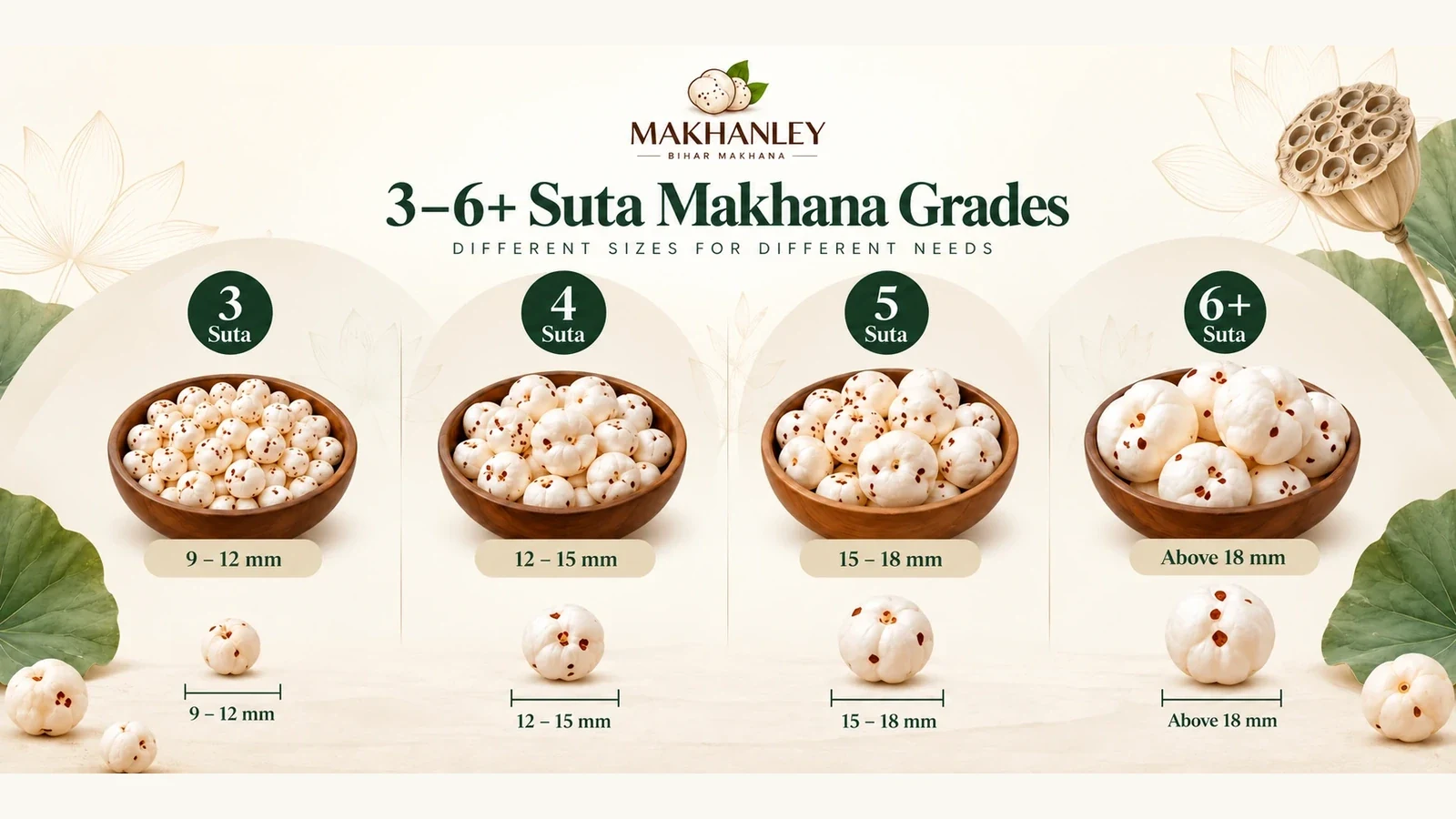
| Makhanley grade | Indicative diameter | Possible brand application |
|---|---|---|
| 3 Suta | 9–12 mm | Smaller kernels and ingredient applications. |
| 4 Suta | 12–15 mm | General snack and wholesale uses. |
| 5 Suta | 15–18 mm | Retail snacks where a medium kernel size works. |
| 6+ Suta | Above 18 mm | Larger kernels and premium visual presentation. |
These are Makhanley's indicative commercial size references, not a universal grading standard used by every supplier. Actual lot distribution, measurement method and acceptable tolerance should be agreed before purchase. Brand owners can compare the dedicated 3 Suta supply details, 4/4+ Suta options, 5/5+ Suta grade information and 6+ Suta large-kernel range before agreeing on a sample.
How should a brand choose?
- Plain snack packs: compare the appearance and eating experience across 4, 5 and 6+ Suta.
- Flavoured makhana: check how the selected kernel size performs through roasting, seasoning and packing.
- Premium positioning: larger kernels may be visually attractive, but verify the product and selling price rather than assuming the largest grade is always best.
- Ingredient use: compare smaller grades if they work better for the recipe and finished-product economics.
Request samples of the grades you are considering. Compare kernel size, expansion, colour, broken pieces, cleanliness, moisture and crispness. Makhanley can help you compare the current available grade and lot before you confirm a commercial requirement.
See the complete Makhana Suta Grades and Sizes guide.
05 · Product development
Develop and test your first product before ordering at scale
Launching ten flavours and several pack sizes at once can make a new brand expensive and difficult to manage. Each variation may need its own formulation, packaging artwork, label review, testing, inventory and marketing.
Start with a small, focused range
A practical first range might include one plain product and one or two roasted or flavoured options. Choose the options based on your target customer and what competing products are already selling.
Use a sample and pilot process
- Request samples of the Suta grades you are considering.
- Compare product appearance, texture, crispness and breakage.
- Test the proposed flavour profile with a small group of target customers.
- Confirm the final ingredient list and product specification.
- Prepare draft packaging and calculate the expected shelf price.
- Estimate landed cost, fulfilment and marketing costs.
- Place a commercial pilot only after the product and label plans are clear.
At Makhanley, you can discuss plain popped makhana, roasted makhana and flavoured private-label products. Share the concept, desired grade, flavour direction, pack size and opening quantity so we can review the appropriate product and commercial arrangement.
06 · US food regulation
FDA, FSMA and FSVP: what a US brand owner must understand
Importing makhana into the USA is a food-regulatory exercise as well as a commercial purchase. The importer, foreign facility and brand owner may have different responsibilities. These duties depend on the product, the parties involved and applicable exemptions.
FDA is not a product endorsement
The US Food and Drug Administration regulates most foods sold in the United States. FDA food-facility registration is not the same as FDA approval of a supplier, food product, label or shipment. Avoid describing a supplier or product as “FDA approved” simply because a facility has a registration number.
Food facility registration
Foreign facilities that manufacture, process, pack or hold food for consumption in the United States generally must register with FDA unless an exemption applies. A foreign facility subject to registration must designate a US agent. Required facilities must renew their registrations during the applicable biennial renewal window.
What is FSMA?
The Food Safety Modernization Act (FSMA) established preventive food-safety requirements. Depending on the facility, food and applicable exemptions, requirements may include hazard analysis, preventive controls, sanitation, supplier controls, corrective actions and records.
What is FSVP?
The Foreign Supplier Verification Program (FSVP) applies to covered US food importers. The FSVP importer is generally the US owner or consignee of the food at the time of entry — the party that owns, has purchased or has agreed in writing to purchase the food. If there is no US owner or consignee at entry, the foreign owner or consignee's US agent or representative may serve in the specified circumstances with the required signed consent.
Unless an exemption or modified requirement applies, the FSVP importer must establish and carry out the required risk-based supplier-verification activities. These can include hazard analysis, supplier evaluation and approval, verification activities, corrective action and recordkeeping.
| Activity | Indian supplier / exporter | US importer / brand owner |
|---|---|---|
| Product specification | Provide accurate product and lot details. | Define intended use and purchasing specification. |
| Supplier records | Provide relevant facility and product records that are available. | Evaluate the supplier and records for its FSVP or other compliance programme. |
| FSVP | Cooperate by supplying required information. | The FSVP importer remains responsible for its legal programme where the rule applies. |
| Prior Notice | Provide accurate shipment information when requested. | Coordinate the filing with the broker or responsible party. |
| US retail label | Supply accurate product, ingredient and processing information. | Ensure the final US label complies with applicable requirements. |
Prior Notice of imported food
FDA generally requires Prior Notice for food shipments imported into the United States unless an exemption applies. The notice must be received and confirmed within the applicable time window before arrival. Coordinate this with the importer, customs broker or authorised filer for the actual shipment.
07 · Quality and testing
What product testing should you consider before selling makhana in the USA?
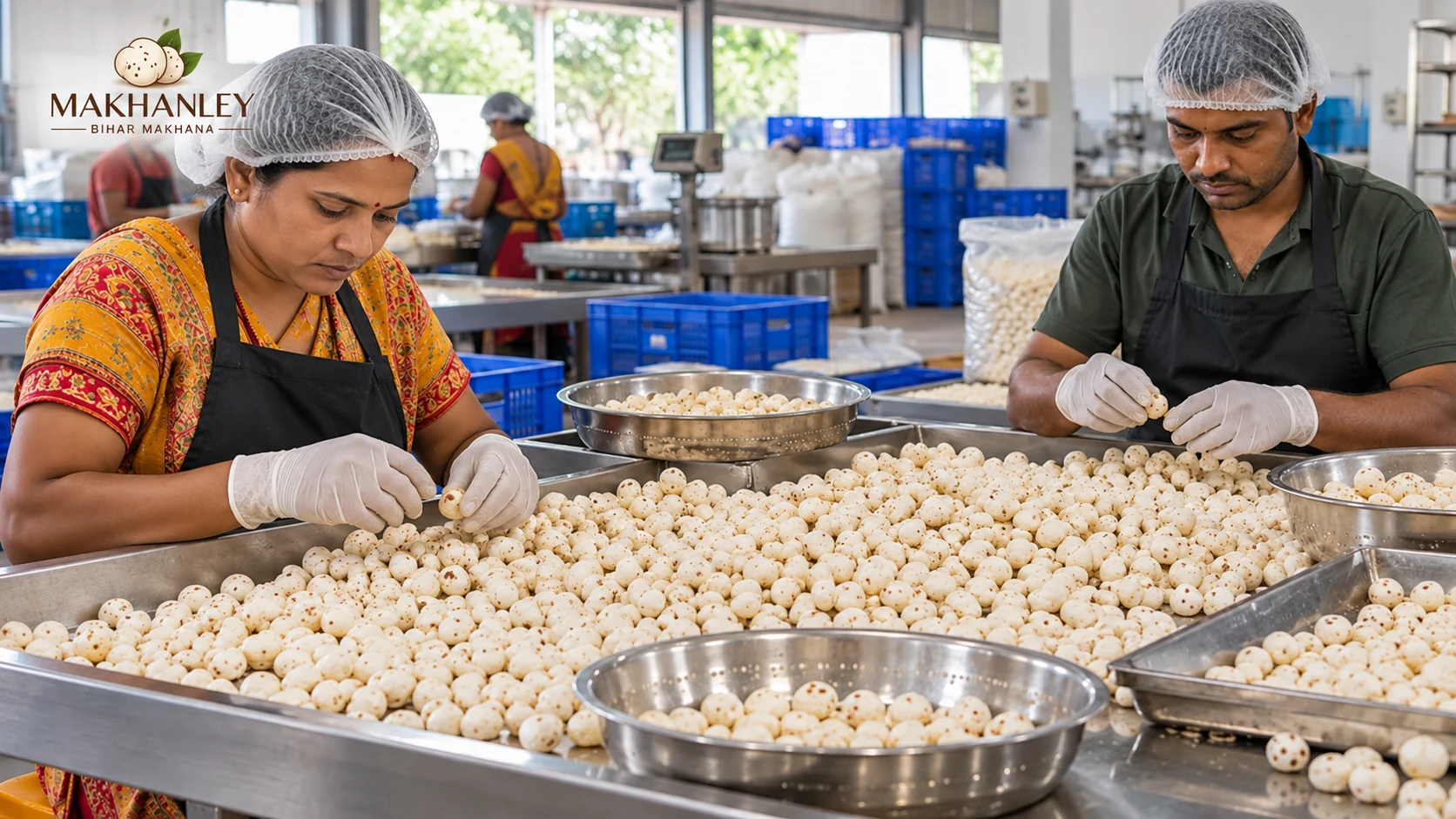
Testing should be planned around the actual product, its ingredients, processing, sourcing risks, customer specification and applicable regulatory requirements. Do not assume every batch needs the same fixed panel of tests, and do not treat a generic certificate as proof for a different lot.
Potential testing categories
Helps assess product condition and storage suitability.
Relevant organisms may include Salmonella, E. coli, yeast and mould, depending on the risk assessment.
Consider applicable contaminants such as lead, cadmium or arsenic where relevant.
Testing scope should reflect sourcing, risk and applicable destination limits.
Consider where the hazard analysis or market requirements call for them.
Use suitable product data to support the Nutrition Facts panel and claims.
What does a Certificate of Analysis (COA) tell you?
A COA reports results for specific parameters tested on an identified sample. Check the product and batch identification, sample collection details, test methods, laboratory name, date, results and applicable limits.
A generic or old COA from another shipment does not prove the results of the current lot. Also, Makhanley's internal cleaning, grading and visual inspection are not the same thing as independent laboratory testing or third-party certification.
We clean and grade the product at our facility and review lots against the agreed product details. Tell us which tests and documents your US customer or compliance adviser requires; we can check the records available for the proposed lot and discuss additional testing arrangements separately.
08 · US labelling
US food packaging and labelling: what should your brand show?
Attractive packaging helps sell a product, but it must also describe the food correctly and meet the applicable US rules. Finalise the formulation before approving the print artwork. A label for plain popped makhana will not automatically fit a seasoned or flavoured SKU.
Common label elements to review
- Statement of identity: a clear, appropriate name for the food.
- Net quantity: the net amount of product in the package in the required format.
- Ingredients: list ingredients in the required order and include applicable sub-ingredients.
- Nutrition Facts: provide the required panel unless a specific exemption applies.
- Responsible business details: include the required manufacturer, packer or distributor name and address.
- Allergen declaration: identify major food allergens where they are used as ingredients.
- Origin marking: ensure country-of-origin statements are accurate and meet applicable customs and consumer-protection rules.
Allergen declarations
US law identifies nine major food allergens: milk, eggs, fish, Crustacean shellfish, tree nuts, peanuts, wheat, soybeans and sesame. Plain makhana itself is not one of these nine major allergens, but a flavoured product may contain one or more of them through seasoning, coatings or other ingredients. Shared-equipment and cross-contact risks should also be assessed.
Do not add a “Contains: None” statement by default. The label must accurately reflect the ingredients and allergen controls for the actual SKU.
Nutrition and health claims
Claims such as “high protein”, “good source of fibre”, “low fat”, “gluten-free”, “heart healthy” or “weight-loss snack” should not be copied from a competitor. Nutrient-content claims have defined criteria, and health claims need appropriate substantiation and legal review. Use nutrition data for your own finished product and serving size.
Country of origin and “Made in USA” claims
If the makhana is sourced and processed in India, do not describe the imported product as unqualified “Made in USA” merely because a US company owns the brand or repacks it there. The FTC's unqualified Made in USA standard generally requires the product to be “all or virtually all” made in the United States. Discuss a truthful and appropriately qualified origin statement with your customs and labelling adviser.
Organic claims
Do not assume that an Indian organic certificate automatically permits USDA Organic claims in the USA. USDA ended its organic recognition agreement with India's APEDA in 2021. Organic products imported from India into the USA must be certified by a USDA-accredited certifying agent, with the required NOP Import Certificate and supply-chain compliance.
Before printing, have the complete label reviewed against the actual ingredients, Nutrition Facts, allergens, origin, pack size and claims. A label correction after printing can be expensive.
09 · Packaging and private label
Choose packaging that protects the product and fits your brand
Makhana is light and can absorb moisture from the surrounding air. Packaging must protect the product during storage, shipment and retail handling while presenting the brand clearly.
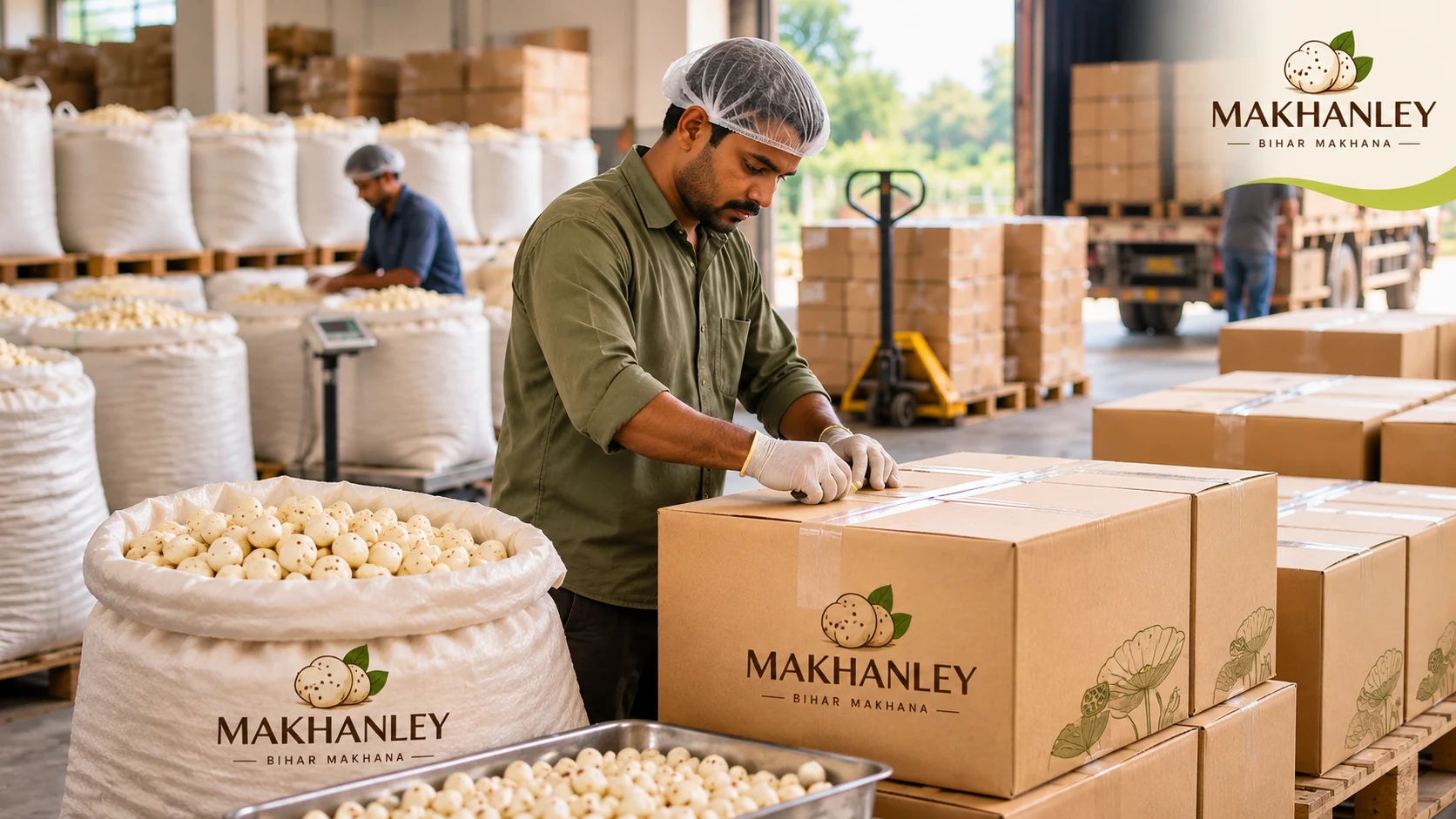
Bulk packaging
If you plan to import plain popped makhana and pack it in the USA, confirm food-contact suitability, bag material, inner liner, net weight, sealing, outer protection and moisture-barrier requirements.
Retail-ready and private-label packaging
If you want to launch a branded snack, discuss pouch format, pack size, resealable features, printing, label artwork and the number of SKUs. Makhanley supplies roasted and flavoured makhana through its private-label offering and can work with buyers on customised branding and packaging.
The brand owner should provide the approved artwork and final product information. Ingredient lists, allergens, nutrition data, net quantity, origin wording and other mandatory statements must be checked before printing.
Nitrogen flushing and modified atmosphere packaging
Nitrogen flushing or modified atmosphere packaging (MAP) may be considered for particular packaged-food applications, but they should not be assumed necessary or effective for every makhana product. The packaging system needs to be suitable for the product and supported by seal-integrity and shelf-life validation.
Set shelf life using evidence
There is no single shelf-life figure that should automatically be applied to plain popped, roasted and flavoured makhana. Shelf life depends on product moisture, ingredients, processing, packaging barrier, seal quality and storage conditions. Do not print a 12-month or 18-month shelf-life statement simply because another brand uses one.
Agree the product and packaging specification first, then establish the shelf life through an appropriate assessment for the finished product and its intended storage conditions.
10 · Brand positioning
Build a brand story US customers can understand and trust
Makhana has a distinct origin story: Bihar's ponds and wetlands, farmers who harvest the seeds, traditional popping and the work involved in cleaning and grading the finished kernels. A new brand can use this story to introduce the product to customers who have never tried it.
What your story should explain
- What it is: a popped edible seed from Euryale ferox, commonly sold as makhana or fox nuts.
- Where it comes from: the real sourcing region and the people involved in the supply chain.
- How it is prepared: the actual processing, roasting, flavouring and packing steps for your product.
- Why your brand exists: the customer, flavour, format or product experience you are building.
- What is verified: only use origin, GI, organic, nutrition or quality claims that your records support.
For a brand using Mithila origin, do not use the official GI logo or describe the product as GI-authorised until you have verified that the producer and relevant product lot meet the registered requirements and the use is authorised. A genuine regional story is still valuable without overstating certification.
Makhanley can share information about its Darbhanga base, farmer relationships, processing operation and product supply for a buyer's own sourcing story. Link your packaging and website story to evidence that can actually be supported.
11 · US market entry
How to market your makhana brand in the USA
Choose sales channels that fit your customer and operating budget. A brand selling to Indian-American consumers may start with different retailers from a brand targeting mainstream snack shoppers or food manufacturers.
Explain the product, origin, ingredients, nutrition, brand story and fulfilment clearly. Use it to collect customer feedback and build repeat purchases.
Review the current food-category, listing, packaging, expiry-date and fulfilment rules before preparing marketplace inventory.
Approach South Asian retailers and distributors with samples, a wholesale price, case configuration and replenishment plan.
Prepare a clear product pitch, wholesale margin, pack size, ingredient and shelf-life information for specialty food buyers.
Show how the product is eaten, explain what makhana is and introduce the Bihar origin. Keep nutrition and health claims substantiated.
Offer product specs, sample packs, price breaks and a repeat-supply plan for businesses that may purchase larger quantities.
Make the product easy to understand
For customers unfamiliar with makhana, explain the name, how it is eaten and what makes your product different. Plain and flavoured products may need different product photography, descriptions and serving suggestions.
Track repeat purchases, customer feedback, returns and advertising cost. A product that gets clicks but does not sell again is not yet a successful brand.
12 · Commercial planning
Calculate the real cost of launching your makhana brand
Do not calculate your profit using only the Indian purchase price and the expected US retail price. There are several costs between buying the product and getting paid by a customer.
| Cost area | What to include |
|---|---|
| Product | Grade, quantity, plain or finished product. |
| Processing | Roasting, flavour, ingredients and agreed processing. |
| Packaging | Bulk bags, inner liners, pouches, printing and labels. |
| Quality and compliance | Required tests, label review, regulatory advice and any certification that applies. |
| India logistics | Movement to dispatch point, export handling and documents. |
| International freight | Sea or air freight and insurance as agreed. |
| US import and delivery | Customs broker, duties and taxes, port charges, warehouse and local delivery. |
| Sales and marketing | Marketplace fees, payment fees, retailer margin, fulfilment, returns and advertising. |
Estimate landed cost before setting the retail price
Your landed inventory cost should include the product purchase price, processing and packaging, applicable India-side expenses, international freight and insurance, destination handling, customs costs and local delivery. Then add marketplace or retailer costs, warehousing, marketing and operating expenses to calculate a realistic contribution margin.
Plan working capital
Funds may be tied up in supplier advances, balances before dispatch, transit, customs clearance, warehouse inventory and marketing before the product generates revenue. Avoid placing a large first order simply because a full container appears cheaper per kilogram. Match the opening quantity to a credible sales plan.
13 · Practical action plan
From first sample to commercial launch: a practical roadmap
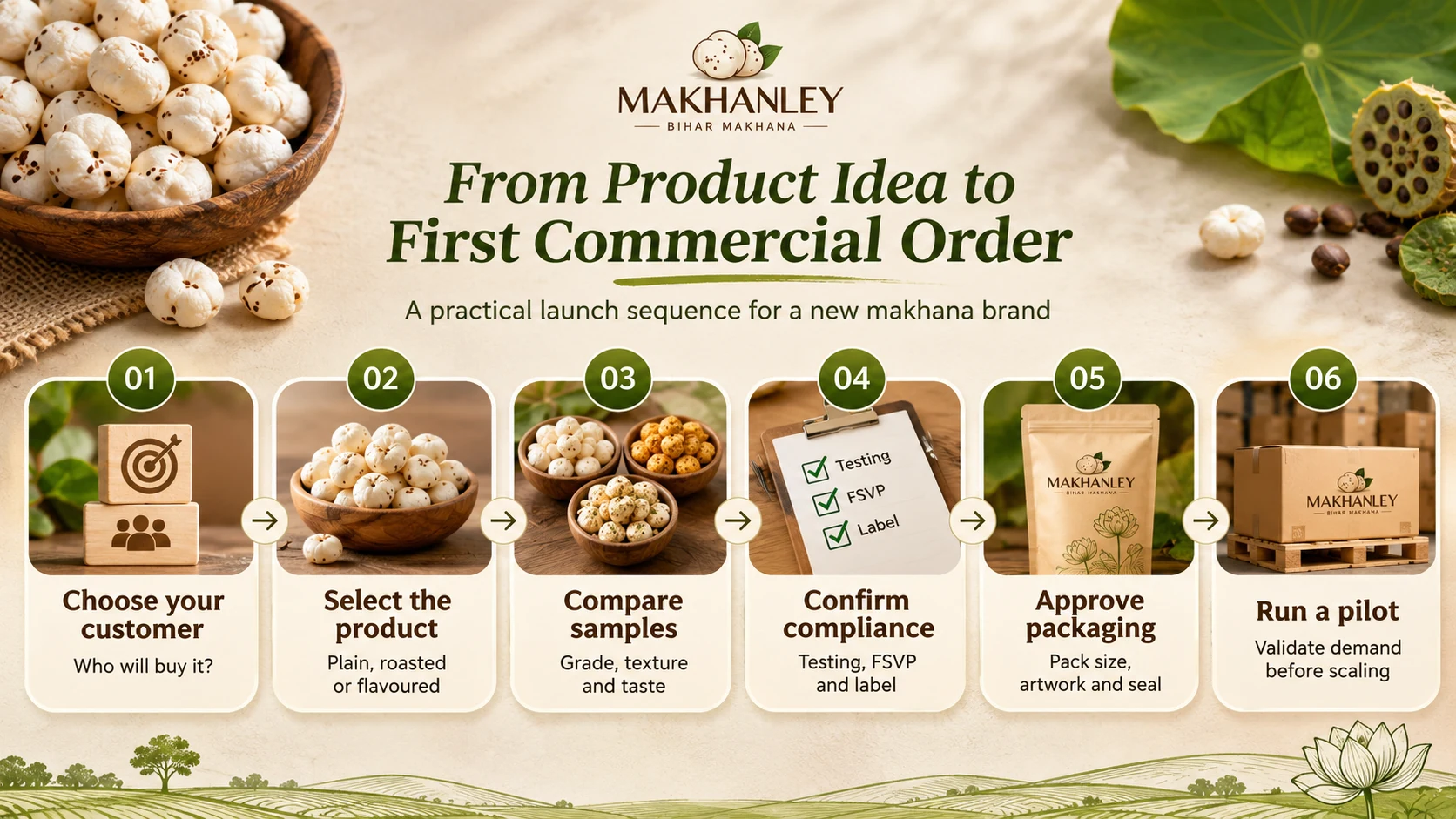
- Research the customer: identify who will buy your product and where they shop.
- Choose the product: decide plain, roasted or flavoured and define the target grade.
- Compare supplier samples: check size, appearance, texture and suitability.
- Plan US compliance: identify the FSVP importer, facility and label requirements, and the testing scope.
- Approve packaging: confirm ingredients, pack size, artwork, sealing and shelf-life evidence.
- Run a pilot: launch a manageable first quantity, learn from sales and customer feedback, then scale.
The time required depends on the product, regulatory preparation, testing, packaging and shipping route. There is no single launch timeline suitable for every brand.
14 · Sourcing partner
Why consider Makhanley for your makhana brand?
Your Indian supplier becomes part of your product and brand operation. You need a business that understands the product, can discuss the required grade and pack format, and can provide clear information about sourcing, processing and supply.
Makhanley works directly with farmers across Bihar through dedicated collection centres, with each inventory lot traceable to its source.
Our operation is based in Adhloam, Darbhanga, within the Mithila region of Bihar.
We clean, grade and inspect popped makhana at our own facility.
Our standard commercial range gives brand owners several sizes to compare for their product.
We supply plain white popped makhana in bulk and roasted or flavoured makhana through our private-label offering.
We work with private-label buyers on product format, flavour, pack size, branding and packaging requirements.
Our role is to support product sourcing, processing and export supply. The US importer or brand owner remains responsible for the compliance obligations that apply to its own import and retail business.
Explore About Makhanley, our Makhana Export from India service and How Makhana Is Made.
15 · Start a conversation
What should you share when contacting an Indian makhana manufacturer?
You do not need a finished business plan before speaking with a supplier. But sharing a few details helps us understand the product you want to launch.
| Information | What to share |
|---|---|
| Business | Company or brand name, website if available, and business location. |
| Product | Plain, roasted or flavoured; required Suta grade; intended pack size and use. |
| Quantity | Sample requirement, estimated first order and expected repeat volume. |
| Packaging | Bulk bag or retail pouch, preferred material, branding and artwork. |
| Compliance | Testing, labelling, FSVP, organic or GI documentation requirements, if any. |
| Shipping | Destination city or port and expected purchasing timeline. |
Makhanley can review your product concept, grade, quantity, destination and private-label requirements and discuss the relevant product options and commercial terms.
Build your makhana brand with a Bihar-based sourcing and manufacturing partner.
Share your product idea, preferred flavour, grade, quantity and packaging needs. We can discuss plain, roasted and flavoured private-label supply from Darbhanga, Bihar.
Common buyer questions
Frequently Asked Questions
Can I start a makhana brand in the USA using an Indian supplier?
Yes. You can source makhana from an Indian manufacturer or exporter and sell it under your own brand, subject to the applicable US food-import, safety, labelling and business requirements.
What is Mithila Makhana and why does it have a GI tag?
Mithila Makhana is registered as a Geographical Indication in India. The official GI Registry records certificate number 421 dated 16 August 2022 and lists Bihar as the registered geographical area.
Can any Bihar-based company use the official Mithila Makhana GI logo?
No. A Bihar address by itself should not be treated as automatic permission to use the official GI logo. The product must meet the registered conditions and use must be supported by the relevant authorised-user or rights-holder documentation. Confirm the position before printing packaging.
Does Makhanley supply roasted and flavoured makhana for private labels?
Yes. Makhanley supplies roasted and flavoured makhana through its regular private-label offering, alongside plain white popped makhana in bulk. Buyers can discuss flavour direction, ingredients, pack size, branding and packaging.
Which Suta grades can I source from Makhanley?
Makhanley's standard commercial range is 3, 4/4+, 5/5+ and 6+ Suta. These are indicative size references; the actual lot distribution and acceptance tolerance should be agreed before ordering.
Who is responsible for FSVP compliance?
The FSVP importer is generally the US owner or consignee of the food at the time of entry. If there is no US owner or consignee, the foreign owner or consignee's US agent or representative may serve in the specified circumstances. The party that qualifies as the FSVP importer is responsible for the applicable verification programme.
Does FDA approve an imported makhana product before it can be sold?
FDA does not generally pre-approve individual food products or suppliers. Imported foods and facilities must meet applicable FDA requirements, and importers must complete the relevant import and verification steps.
Do I need a COA for every shipment?
Not every shipment automatically requires the same testing panel. The scope should follow the product risk assessment, buyer specification and applicable destination requirements. A COA should identify the product and lot tested, parameters, method, lab and results.
Can Makhanley help with private-label packaging?
Yes. We supply roasted and flavoured makhana through private-label arrangements and can discuss custom branding and packaging requirements. Finalise the product, label details, pack size and commercial terms before production.
How can I request a quotation?
Visit the Makhanley Bulk Supply enquiry form and share your product format, required grade, quantity, destination and packaging needs.
Research and official regulatory references
Use these primary sources to verify current GI, US food-import, labelling and origin-claim requirements. Rules can change, and the exact product and transaction should be reviewed before a commercial launch.
- IP India — Official GI Registry entry for Mithila Makhana (Application 696 / Certificate 421)
- APEDA–ICRIER — Strategies to Boost India's Makhana Exports (2025)
- IP India — Geographical Indications of Goods (Registration and Protection) Act, 1999
- USPTO — Geographical Indications (GI) Protection in the United States
- FDA — FSMA Final Rule on Foreign Supplier Verification Programs (FSVP)
- FDA — Small Entity Compliance Guide for FSVP Importers
- FDA — FSMA Frequently Asked Questions, including food facility registration and importer responsibilities
- FDA — Prior Notice of Imported Food Shipments
- FDA — Food Allergies and Major Allergen Labelling
- USDA AMS — Organic Certification and Imports from India
- Federal Trade Commission — Complying with the Made in USA Standard
This guide is general educational information, not legal, customs, regulatory or tax advice. Requirements vary by product formulation, facility, importer, shipment and destination. Confirm the current rules with your US regulatory adviser, customs broker and relevant authorities before ordering or selling food.