

Looking for a bulk makhana supplier or fox nut exporter in India?
Whether you are importing for wholesale distribution, manufacturing snacks or building a private-label brand, choosing the right exporter involves more than comparing the price per kilogram.
You need to know which product formats are available, how the grade is described, what checks are performed on a lot, which documents can be provided, how the product will be packed and what the complete shipping cost may look like.
Makhanley is a Bihar-based manufacturer, bulk supplier and exporter located in Adhloam, Darbhanga. We work directly with more than 100 farmers through collection centres in Darbhanga, Purania and Madhubani. Our own facility carries out cleaning, grading, hand-selection, metal detection, dehumidification and third-party lot testing.
Know Makhanley and our operations →Our standard bulk range includes plain white popped makhana. We also supply roasted and flavoured makhana through our regular private-label offering, with custom branding and packaging for food businesses. Raw unpopped seeds, flakes and powder are different formats and are not part of our standard published range.
01 · Product basics
What is makhana? Understanding the product before importing
Makhana is the edible popped seed of the aquatic plant Euryale ferox. It is commonly called fox nut, gorgon nut or phool makhana in different markets. It is not the same plant as the true lotus, Nelumbo nucifera, so the botanical name matters when preparing product specifications and customs paperwork.
For international trade, buyers should describe the product clearly: plain white popped makhana, roasted and popped kernels, flavoured snack, raw unpopped seed or another processed form. These are not automatically interchangeable for product classification or food-regulatory purposes.

Bihar is India's leading makhana-producing region. The APEDA–ICRIER study on India's makhana exports describes the production and processing chain in North Bihar, including cultivation, harvesting, seed handling, popping, grading and trade. Buyers who understand these stages can ask better sourcing questions.
Makhanley operates from Adhloam, Darbhanga, within the Mithila region, and works with farmer relationships across Bihar. Read more about makhana growing regions and sourcing in Bihar.
02 · From farm to export
How does makhana reach an exporter in India?
Makhana does not always travel directly from the farmer to the exporter. In one common route, raw seeds move through a local collector or trader, a processor, a wholesaler or stockist and then an exporter. The actual chain varies: one business may perform more than one role, and some exporters work directly with processors.
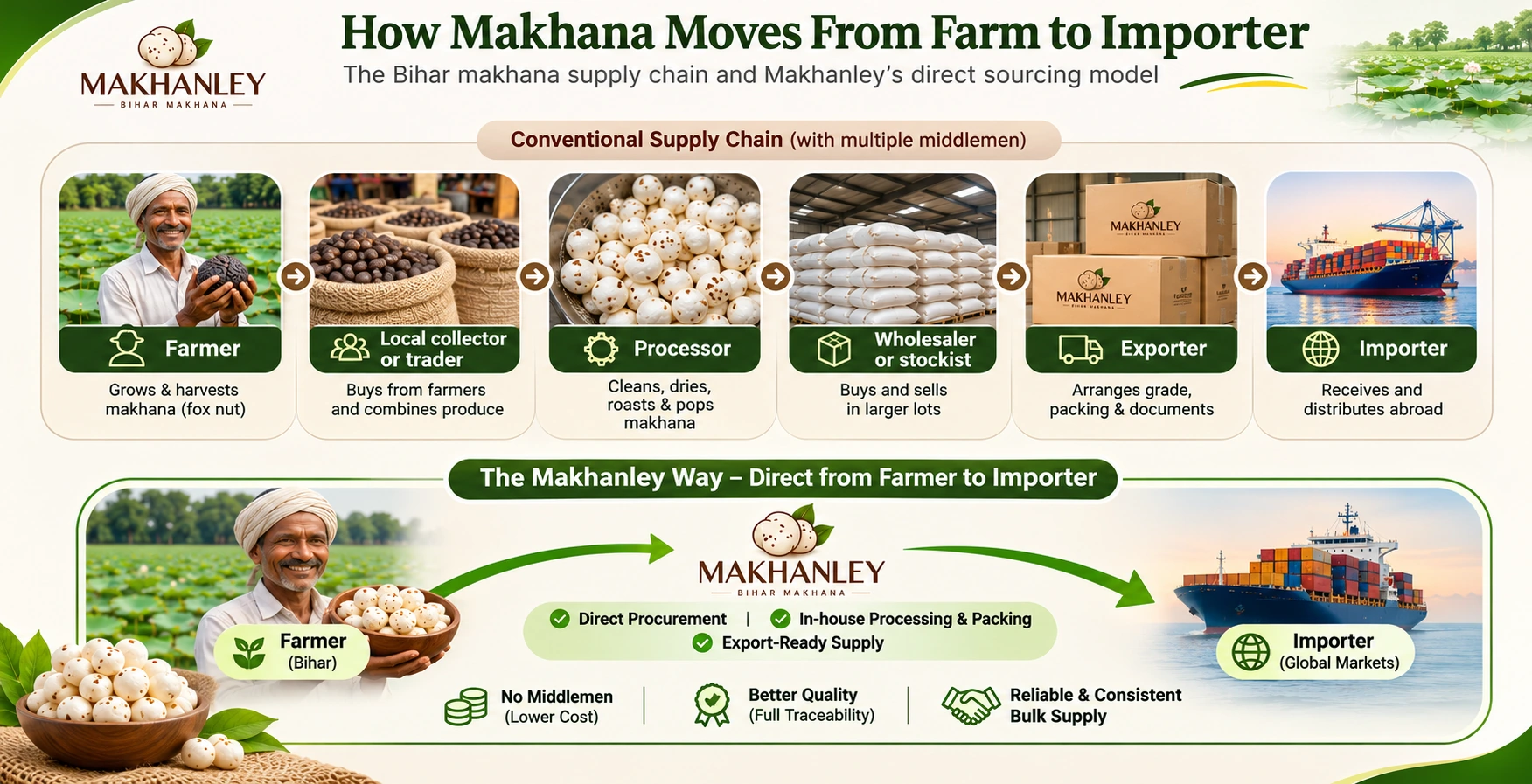
Where does Makhanley fit?
Makhanley works directly with more than 100 farmers across Bihar through dedicated collection centres in Darbhanga, Purania and Madhubani. The inventory is traceable to its source and moves to our Darbhanga facility for cleaning, sieve and automated grading, manual hand-selection, metal detection, dehumidification and third-party lot testing.
This model gives buyers a direct commercial conversation with the business handling the product and export enquiry, rather than requiring them to coordinate separately with unrelated stockists and exporters. A more connected sourcing and processing model can reduce unnecessary trading layers and support competitive pricing; it does not mean every cost or intermediary disappears.
There are real costs at each stage: harvesting, traditional popping, labour, cleaning, sorting, grading, storage, transport, packaging and export handling. The useful question is not simply how many people are involved, but what work and value each stage adds.
We procure directly from farmers through dedicated collection centres and process each lot at our own facility. Buyers can discuss grade, quantity, lot specifications and packaging requirements directly with Makhanley.
See how makhana moves from pond to pack →03 · What can be supplied?
What types of makhana can you buy in bulk?
Not every makhana supplier sells the same product format. Before requesting a quotation, tell the exporter whether you need a plain ingredient, a ready-to-eat snack or a branded finished product.
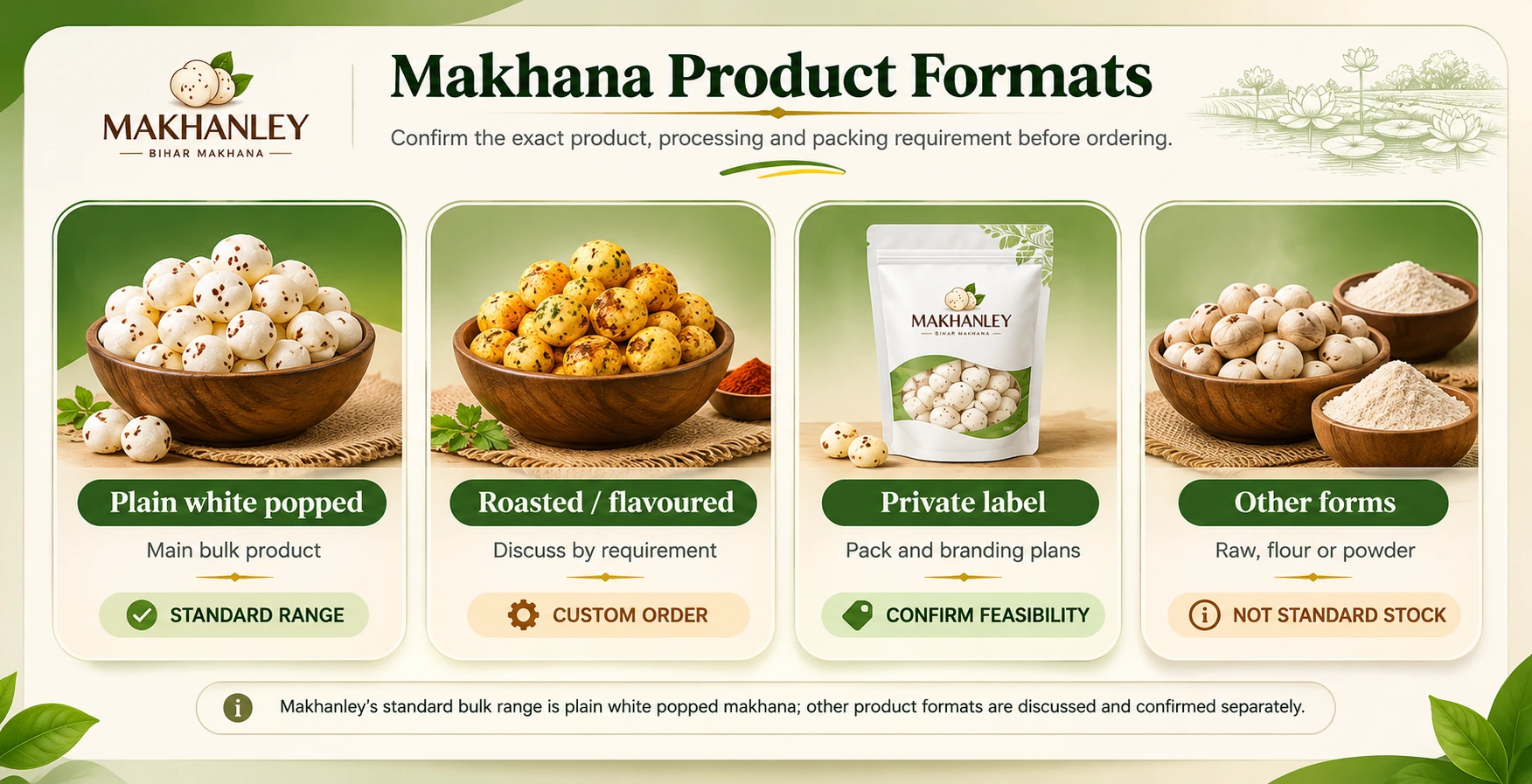
Plain white popped makhana
This is Makhanley's main bulk product. Popped kernels are cleaned, graded and inspected before bulk supply. Buyers include wholesalers, distributors, food manufacturers, repackers and retail brands.
Share the Suta grade, target quantity, intended use and packaging preference. We can review the requirement against the current available lot. Explore plain white popped makhana bulk supply →
Roasted and flavoured makhana
Makhanley also supplies roasted and flavoured makhana as part of its regular private-label offering. Buyers can discuss flavour directions such as peri-peri, mint or pudina, and salt-and-pepper, along with the ingredient list, pack size, branding and packaging needed for their brand. The final SKU specification, quantity and commercial terms are agreed before production.
Private-label makhana
Private-label businesses sell products under their own brand while arranging production and packing through a supplier. Makhanley provides private-label supply for roasted and flavoured makhana, including custom branding and packaging. Buyers can align the flavour, ingredients, pack size, artwork, label details, order quantity and commercial terms with our team before production. Buyers planning a branded retail range can review our private-label manufacturing service for the flavour, artwork and pack-format discussion.
Raw unpopped seeds, flakes and powder
Raw unpopped seeds are the hard seeds collected before roasting and popping. Makhana flour or powder is a further-processed ingredient. These are different products from the plain white popped kernels in Makhanley's published standard bulk range. Buyers needing these formats should ask separately; do not assume they are ready stock.
Modified atmosphere packaging (MAP)
MAP uses a controlled gas environment inside a sealed package. It may be relevant for some retail applications, but it is not a standard requirement for every bulk order. Do not assume that a supplier offers validated MAP or nitrogen-flushed packaging. Any special gas-flushed pack must be confirmed against the product, packaging supplier and shelf-life evidence before being included in a quotation.
04 · Grade and size
Understanding makhana Suta grades and sizes
Suta is a trade reference used to describe the size of popped makhana. Larger Suta grades generally refer to larger kernels, but size alone does not prove better overall quality or freshness.
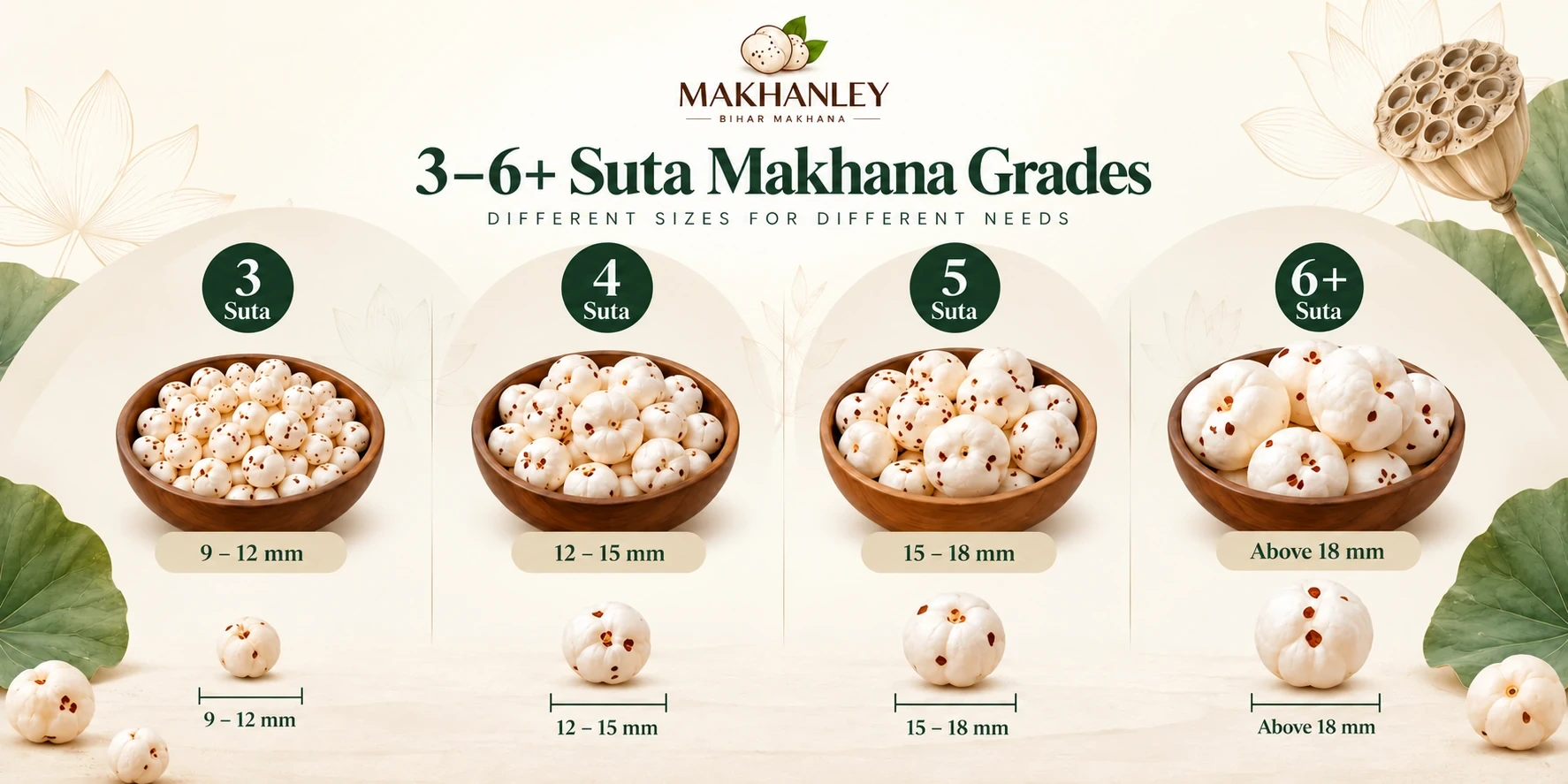
| Makhanley grade | Indicative popped-kernel diameter | Buyer consideration |
|---|---|---|
| 3 Suta | 9–12 mm | Smaller kernels; evaluate for processing and traditional preparations. |
| 4 Suta | 12–15 mm | Smaller commercial kernels for mixes and flavouring applications. |
| 5 Suta | 15–18 mm | Useful comparison grade for regular snacking and retail presentation. |
| 6+ Suta | Above 18 mm | Larger-kernel category where size and presentation matter. |
These are Makhanley's published indicative grade references, not a universal grading standard used by every trader or industry report. Other grading systems may use different bands or labels. Always confirm the supplier's actual size range, sampling method and acceptance tolerance in writing.
Which Suta grade should you buy?
- Food processing: compare 3 and 4 Suta if smaller kernels suit your recipe, yield and processing method.
- Regular snack packs: compare 4 and 5 Suta against the appearance you want in the retail pack.
- Premium presentation: evaluate 5 and 6+ Suta if larger kernels are important to the product positioning.
- Wholesale distribution: base your grade mix on what your customers actually buy rather than assuming one size fits every market.
At Makhanley, our current published commercial range is 3, 4/4+, 5/5+ and 6+ Suta. We discuss the grade and actual lot size distribution before confirming the order. See our Makhana Suta Grades and Sizes guide. For grade-specific commercial requirements, compare 3 Suta bulk supply, 4/4+ Suta grade options, 5/5+ Suta wholesale specifications and 6+ Suta large-kernel supply.
05 · Product specification
Technical specifications to confirm before buying bulk makhana
A quotation that simply says “5 Suta premium makhana” is not a complete purchase specification. Two suppliers may use the same grade name while supplying different size distributions, breakage levels and appearance.
Important quality parameters
- Kernel size and distribution: agree the diameter range and how mixed or borderline sizes will be treated.
- Whole and broken kernels: specify the acceptable broken or damaged percentage, especially for transparent retail packs.
- Colour and appearance: define the expected colour, uniformity and visible defects.
- Expansion: assess whether kernels are properly expanded or include flattened and irregular pieces.
- Moisture: agree the target, test method, sampling point and acceptance criteria. Do not copy a generic moisture figure without checking the product and destination requirements.
- Cleanliness: agree the acceptable level of dust, shell, foreign matter and visibly damaged material.
- Crispness and sensory quality: for snack applications, evaluate crispness, taste, odour and product condition.
- Packaging: confirm food-contact suitability, inner liner, bag weight, sealing and moisture protection.
How does Makhanley check the product?
At our Darbhanga facility, popped makhana is cleaned, graded and reviewed against the grade and quality points discussed for the particular order. Internal visual or grading checks are not the same as independent laboratory testing.
If you require a Certificate of Analysis (COA), microbiological report, heavy-metal report or pesticide-residue testing, tell us the parameters and destination market at the enquiry stage. We will check whether an applicable report is available for the lot or whether separate testing needs to be arranged. Testing scope, laboratory, cost and timing must be agreed before the commercial order.
Recommended lot specification sheet
| Particular | What to agree |
|---|---|
| Product | Plain white popped makhana or agreed finished product. |
| Grade and size | Suta grade, indicative millimetre band and tolerance. |
| Whole / broken | Acceptance criteria and inspection method. |
| Appearance | Colour, expansion and visible defect criteria. |
| Moisture | Specification, sample point and method. |
| Foreign matter | Agreed acceptance limit. |
| Testing | Required parameters and whether batch-specific reports are needed. |
| Packaging | Bag material, net weight, seal and label requirements. |
| Batch and inspection | Lot identifier, sample approval and inspection procedure. |
06 · Documents and evidence
What documents should you request from a makhana exporter?
Documents depend on the product form, destination, customs classification and buyer's requirements. It is useful to separate business credentials, product/lot evidence and shipment documents.
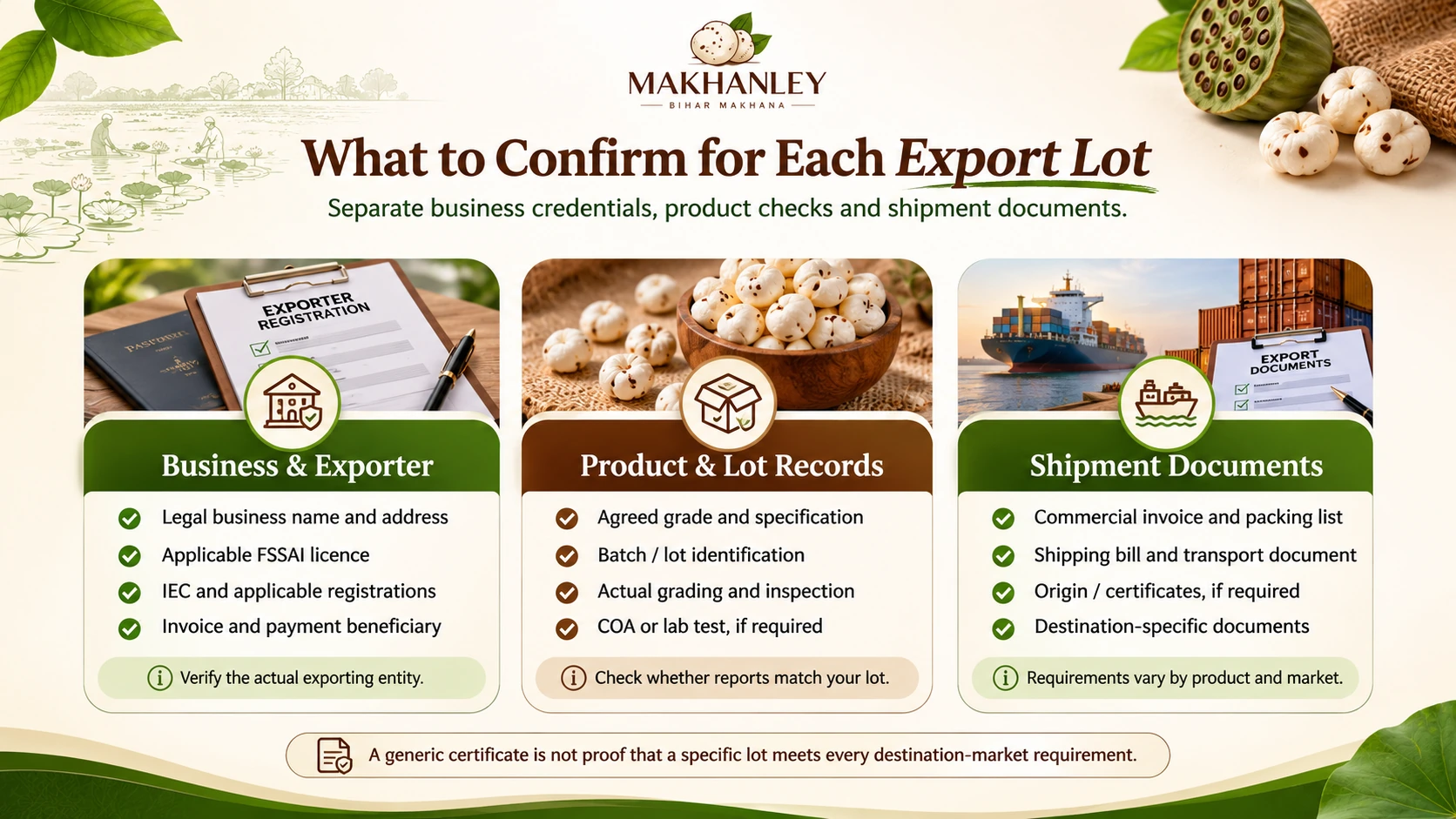
Business and exporter details
Verify the legal business name and address, applicable FSSAI licence, Importer Exporter Code (IEC) and any other relevant registrations. Make sure the invoice issuer, contracting entity and payment beneficiary make sense together. If an export-promotion registration is relevant to the exact product category, confirm its applicability rather than assuming every food export needs the same registration.
FSSAI states that food business operators in India must hold the applicable licence or registration. DGFT's Foreign Trade Policy generally requires an IEC for import/export of goods, subject to specified exemptions. APEDA's RCMC process applies to APEDA scheduled products; exporters should verify whether their exact product category falls within the schedule.
Commercial and shipping documents
- Commercial invoice: product description, quantity, value, buyer and seller details.
- Packing list: package count, net and gross weight and pack details.
- Shipping bill: Indian customs export declaration.
- Bill of lading or air waybill: relevant transport document.
- Certificate of origin: where required by the buyer, customs authority or trade arrangement.
- Insurance document: where insurance is arranged under the agreed delivery terms.
Product quality and testing records
A product specification sheet records the grade and agreed lot parameters. An inspection or grading record documents the checks actually performed. A COA is a laboratory-issued report showing the test results for specified parameters. Microbiological and contaminant testing may be needed depending on the product, buyer and destination.
What can Makhanley provide?
Tell us the documents and tests your buyer or destination market requires. We will check the relevant business, product and lot information available for the proposed order and identify any additional testing or certification that needs to be arranged. The exact scope should be agreed before order confirmation, not assumed from a general “export quality” statement.
07 · Destination-market checks
Export requirements for the USA, European Union, UK and Singapore
Indian export paperwork is only one part of an international food shipment. The importer must also confirm the food safety, labelling, customs and product-specific rules in the destination country.
USA
Check applicable FDA food-facility registration, Prior Notice, labelling and importer responsibilities under the Foreign Supplier Verification Program (FSVP). FDA does not pre-approve each food product or individual shipment.
FDA: Importing food products →European Union
EU Regulation 2023/652 authorises roasted and popped kernels from Euryale ferox as a traditional food from a third country under specific product specifications and conditions. Do not assume this authorisation covers raw seeds, powder, extracts or every flavoured formulation.
Read EU Regulation 2023/652 →United Kingdom
Do not assume that EU authorisation automatically settles Great Britain requirements. Check the current UK Food Standards Agency / Food Standards Scotland regulated-products register and the separate import and labelling rules for the exact product.
Check the Great Britain novel food register →Singapore
Importers of processed food and food-contact articles need the relevant SFA registration. A Cargo Clearance Permit (CCP) is required for each consignment. Product classification, permitted ingredients and labelling should be checked before shipment.
SFA: Processed food import requirements →USA: what the importer should understand
Food imported for sale in the United States must meet the applicable US requirements. Facilities that manufacture, process, pack or hold food for US consumption generally need FDA registration unless an exemption applies, and Prior Notice must be submitted before food is offered for import unless exempt. Covered US food importers have FSVP responsibilities to verify their foreign suppliers. FDA registration is not product approval, certification or a guarantee that a shipment will be admitted.
European Union: product form matters
The EU authorisation is specifically for roasted and popped kernels from the seeds of Euryale ferox, with specifications and conditions set out in the regulation and its annex. It should not be treated as blanket permission for every raw, powdered, extracted or differently processed product. An importer should compare the actual product, processing method, intended use, composition, contaminants and labelling against the authorisation before ordering.
United Kingdom: check the GB register separately
Great Britain maintains its own register of authorised novel foods and regulated products. The importer should verify whether the precise product and intended use are listed and comply with the stated conditions. Northern Ireland may operate under a different applicable framework, so the destination within the UK matters.
Singapore: importer registration and permit
Singapore Food Agency guidance identifies processed food and food-contact articles as requiring the relevant SFA registration. It also states that a Cargo Clearance Permit (CCP) is required for each consignment. The importer should classify the food correctly, check allowed ingredients and additives and ensure prepacked food labels meet Singapore Food Regulations.
What this means when buying from Makhanley
Tell us the destination country, product form, ingredients (if flavoured), retail or manufacturing use, packaging and documents required. Makhanley can review the product and shipment details and discuss the business and lot information available. The buyer and its local importer/customs adviser must confirm destination-market compliance before dispatch.
For export enquiries, explore Makhanley's export supply page or share the destination and product requirements.
08 · Customs description
HS codes and customs classification for makhana
An HS code is used to classify goods for customs and trade statistics. The correct classification can affect export declarations, import duty, restrictions and other customs requirements.
Do not copy an HS code from an old invoice, a supplier's website or a different makhana product. Raw unpopped seeds, plain popped kernels, flour, powder and prepared/flavoured products may not necessarily be classified in the same way in every jurisdiction.
India made makhana-specific changes to its tariff nomenclature in 2025. The exact Indian ITC-HS entry and the importing country's tariff code must still be checked against the current schedule and the precise product form at the time of shipment.
What should the importer and exporter do?
- Write an accurate product description, including botanical name and whether the goods are raw, popped, roasted or further processed.
- Confirm ingredients and preparation method for flavoured or prepared products.
- Ask the Indian customs broker/exporter to verify the current Indian ITC-HS classification.
- Ask the destination customs broker to verify the corresponding import tariff classification.
- Check applicable duty, taxes, restrictions and any product-specific permits using the current official tariff and import rules.
For background, see the DGFT 2025 notification containing the makhana tariff-definition amendment. This guide does not provide a definitive HS code or duty rate; the final classification must be confirmed for the actual goods.
09 · Commercial terms
How is bulk makhana export pricing calculated?
The product price is only one part of the total cost of importing makhana. The final amount depends on grade, quantity, product form, packaging, inland movement, export handling, freight, insurance, destination charges and the FOB or CIF quotation basis agreed with Makhanley.
What affects the bulk price?
- Suta grade: larger and more uniform kernels may command a different price.
- Lot condition: appearance, expansion, whole-kernel percentage and other agreed quality requirements can affect selection and cost.
- Processing: plain popped makhana and further-processed roasted or flavoured products have different processing inputs.
- Quantity: order size affects handling and shipping economics.
- Packaging: bulk sacks, liners, retail pouches and customised private-label packs carry different costs.
- Testing: additional inspection, laboratory testing or certificates may involve separate charges.
- Destination: inland distance, port, route, freight and delivery requirements change the total.
How does Makhanley prepare a quotation?
We prepare quotations around the buyer's actual requirement rather than treating every order as identical. We consider the Suta grade, product format, quantity, packaging, inspection or testing requirements, destination and delivery term. The quotation should state what is included and what will be charged separately.
Makhanley's two quotation bases: FOB and CIF
| Quotation basis | What Makhanley arranges | What the buyer should plan for |
|---|---|---|
| FOB | Export clearance and delivery of the goods on board the vessel at the named Indian shipment port. | Main sea freight, marine insurance, destination import clearance, duty, taxes, port charges and onward delivery. |
| CIF | Export clearance, sea freight and the required cargo insurance to the named destination port. | Destination import clearance, duty, taxes, destination charges not included in the carriage contract and onward delivery. |
Under both bases, risk transfers when the goods are loaded on board the vessel at the Indian port of shipment. A CIF quotation includes seller-arranged freight and required insurance to the named destination port, but it is not automatically a warehouse-delivered price. Always compare the same product specification, quantity and named port.
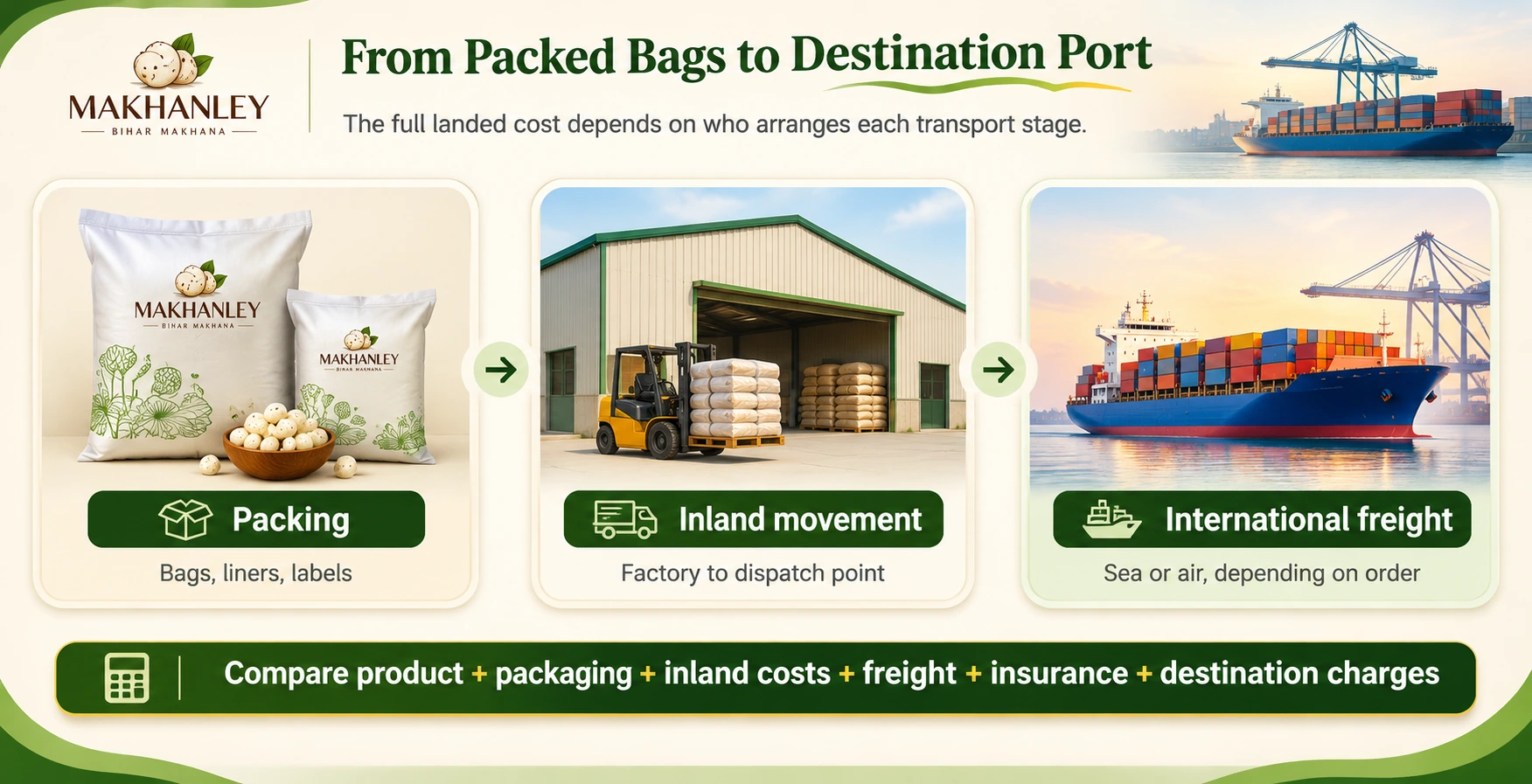
How to estimate landed cost
A buyer's landed-cost estimate may include product cost, Indian inland transportation, export handling, international freight, insurance, destination port and handling charges, customs duty, applicable import taxes, customs brokerage and local delivery. Add only the costs not already included in the seller's quote or delivery term.
Send Makhanley your grade, quantity and destination for a bulk quotation.
10 · Packing and logistics
How should bulk makhana be packed and shipped internationally?
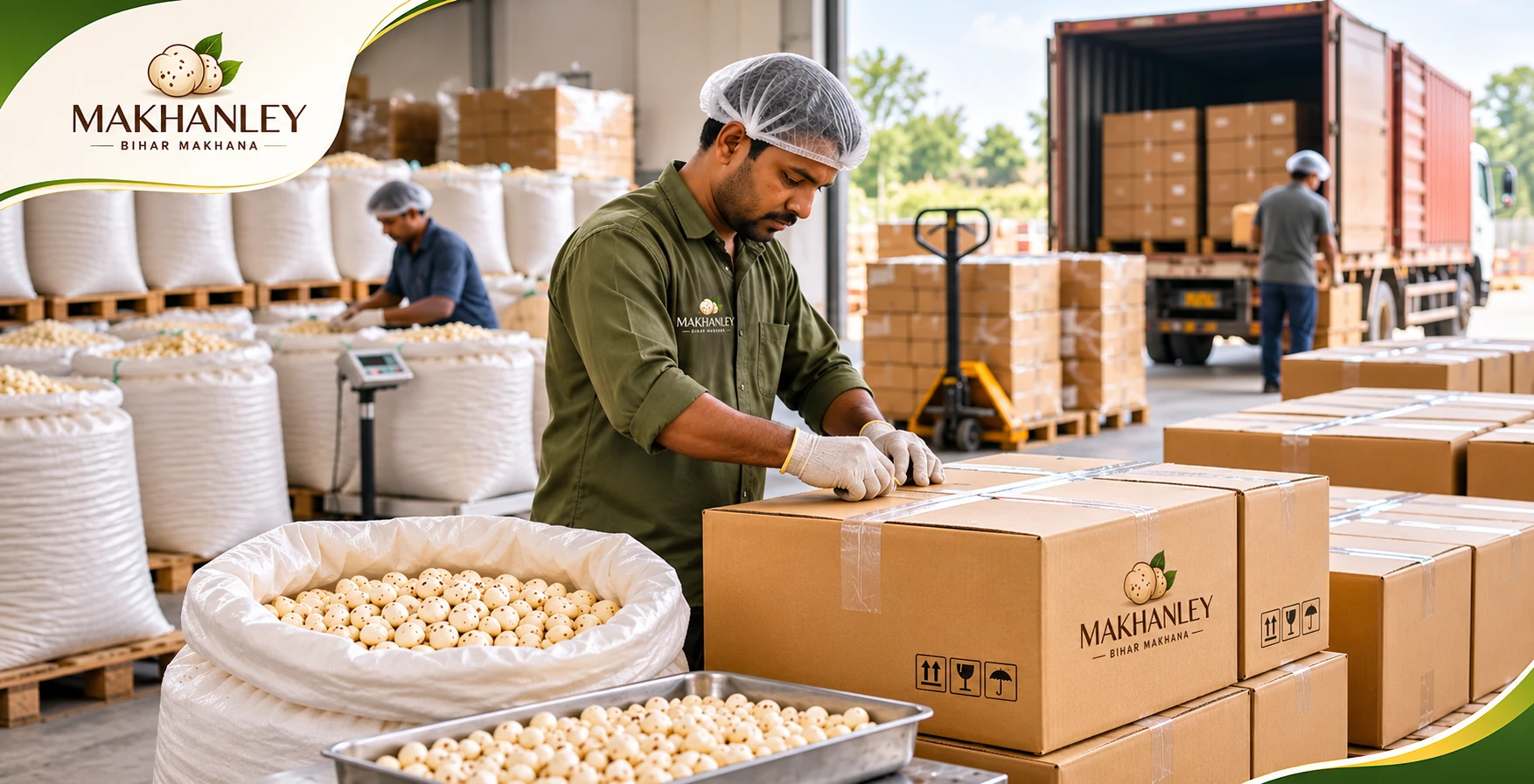
Makhana is light compared with many other food commodities, but it can absorb moisture and may be damaged by rough handling. Packaging and container planning should be discussed before confirming the order.
Bulk packaging: what to confirm
- Food-contact suitability of the packaging material.
- Inner liner, if required by the product and route.
- Bag or carton dimensions and net weight.
- Closure and sealing method.
- Outer protection and handling strength.
- Product, batch, net-weight and other required labels.
- Moisture protection during storage and transit.
Makhanley discusses bulk packaging against the product, intended route and buyer's requirements. Retail pouches or customised private-label packaging require separate confirmation of the material, artwork, pack size, minimum quantity and labelling requirements.
FCL and LCL shipments
FCL (Full Container Load) means the buyer uses a full container for the shipment. LCL (Less than Container Load) means the cargo shares container space with other shipments. Which option makes sense depends on order size, freight rates, route, transit risk and handling arrangements.
20-foot and 40-foot containers
Do not rely on a generic “tonnes per container” figure. Actual loadability depends on bag and carton dimensions, packed density, palletisation, gross weight, container payload, stacking limits, route restrictions and the carrier's requirements. Ask the freight forwarder for a loading plan based on the final packaging details.
Sea freight or air freight?
Sea freight is commonly evaluated for larger, less urgent shipments. Air freight may suit samples, small consignments or urgent requirements where the higher cost is acceptable. Transit time and rates depend on the origin, destination, route, carrier and booking date; confirm them at the time of shipping.
Container condition
Before loading, check that the container is clean, dry, free of strong odours, visible pests and leakage, and suitable for food cargo. Container liners or desiccants may be considered based on route, season, packaging and moisture risk; they are not a substitute for suitable product packaging.
11 · After arrival
How should makhana be stored after import?
Even a well-packed shipment can lose quality if it is stored poorly after arrival. Makhana can absorb moisture, which may reduce crispness and change the product's condition.
- Keep the original bags or pouches properly sealed until use.
- Store in a clean, dry and ventilated warehouse.
- Keep the product away from direct sunlight and water ingress.
- Avoid storing it near chemicals or strong-smelling products.
- Use clean pallets or suitable racking; avoid direct floor contact.
- Maintain pest-control and stock-rotation procedures.
- Inspect packs and seals before distribution.
What is the shelf life of makhana?
There is no single shelf-life figure that should be applied automatically to every product. Shelf life depends on the product form, initial condition, processing, moisture, packaging material, seal integrity and storage conditions. Plain white popped makhana, roasted flavoured snacks and retail-ready private-label packs may require different assessments.
Buyers should request shelf-life support that matches the actual product and packaging being supplied. Do not rely on a generic claim such as “18 months” unless it is supported by an appropriate product and packaging assessment.
At Makhanley, share your intended pack format and market so that the applicable storage and shelf-life information can be discussed for the product being quoted.
12 · Origin and sourcing
Why source makhana directly from Bihar?
Bihar is India's principal makhana-producing state. Areas across North Bihar, including the Mithila region and other production districts, are associated with cultivation and traditional processing. Sourcing close to the production region can help buyers understand the crop, processing stages and local supply network.
Makhanley is based in Adhloam, Darbhanga, Bihar. We work directly with more than 100 farmers through dedicated collection centres in Darbhanga, Purania and Madhubani. Our processing operation handles cleaning, grading, hand-selection, metal detection, dehumidification and third-party lot testing before bulk supply or further processing.
Working relationships with 100+ farmers across Bihar.
Cleaning, Suta grading and quality inspection.
3, 4/4+, 5/5+ and 6+ Suta, with actual lot details confirmed.
Supply discussions for wholesalers, distributors, food businesses and international buyers.
Our model connects farmer-linked sourcing with our own processing and export supply operation. This can reduce unnecessary trading layers and gives buyers one direct point of contact to discuss product requirements and commercial terms.
Learn more about makhana from Bihar, the traditional processing journey and Makhanley's people and operations.
13 · Supplier due diligence
How to evaluate a bulk makhana exporter
Do not choose an exporter based only on product photographs, an attractive quotation or the claim that it is a manufacturer. Check the business, product, documents and order process.
| Area | Questions to ask |
|---|---|
| Business identity | What is the legal name, registered address and invoice entity? |
| Sourcing | Does the business work with farmers, processors, wholesalers or other traders? |
| Processing | Where is the popped makhana cleaned, graded and packed? |
| Product | Which grades and product forms are actually available? |
| Sample | Does the sample represent the proposed bulk lot? |
| Quality | Which checks are performed, and what is recorded? |
| Testing | Do reports identify the actual lot and the parameters tested? |
| Packaging | What materials, weights, seals and moisture protection are offered? |
| Documents | Which exporter and shipment documents can be provided? |
| Commercial terms | What are the MOQ, payment schedule, Incoterm and quotation validity? |
Warning signs to watch for
- The supplier refuses to share basic business details.
- It cannot explain where the product is sourced or processed.
- It avoids providing a representative sample or written specification.
- It claims “export quality” but cannot explain the checks performed.
- It provides old or generic test reports that do not identify the current lot.
- It promises all certifications or unconditional customs clearance without checking the product and destination.
- It offers an unusually low price but will not explain the grade, quality, packing or delivery basis.
- It asks for payment to an unrelated personal account or refuses to put commercial terms in writing.
- It claims that FDA registration means a product or shipment has been FDA-approved.
For a deeper supplier-selection checklist, read our related guide: Reliable Makhana Supplier in India: 5 Problems Importers Face and How to Avoid Them.
14 · Next step
Ready to request a bulk quotation?
Share the product grade, quantity and destination you have in mind. For specific packaging, quality, testing or documentation requirements, add a short note with your enquiry.
Tell us what you need. Makhanley can review the requirement and discuss the available product, lot specifications and applicable export terms.
15 · Working with Makhanley
Why consider Makhanley for bulk makhana supply?
If you are sourcing from Bihar, a supplier with an understanding of the product and its processing stages can make procurement more straightforward. Here is how Makhanley is structured for bulk buyers:
We work directly with more than 100 farmers through dedicated collection centres in Darbhanga, Purania and Madhubani. The produce moves to our own facility for cleaning, grading, manual hand-selection, metal detection, dehumidification and third-party lot testing.
Our business connects farmer-linked sourcing, processing and export supply.
Our Darbhanga facility handles cleaning, Suta grading and quality inspection.
Our published range covers 3, 4/4+, 5/5+ and 6+ Suta, with actual lot details confirmed before order.
We supply roasted and flavoured makhana through our regular private-label offering, with custom branding and packaging.
Buyers can discuss product grade, quantity, destination and commercial details with our team.
We do not ask buyers to rely on a generic “lowest price” or blanket certification claim. We prefer to understand the requirement, identify the relevant product and lot, discuss available evidence and make the commercial terms clear before proceeding.
Looking for a bulk makhana or fox nut exporter in India?
Share your required grade, quantity, product format, destination and packaging needs. Makhanley can review the requirement and discuss current availability and applicable bulk pricing.
Common buyer questions
Frequently Asked Questions
Who is a bulk makhana exporter in India?
A bulk makhana exporter supplies product in commercial quantities and handles or coordinates the requirements for international shipments. Makhanley is a Bihar-based manufacturer, bulk supplier and exporter working directly with 100+ farmers across Bihar.
Which Suta grades does Makhanley supply?
Makhanley's published commercial grade range is 3 Suta (9–12 mm), 4/4+ Suta (12–15 mm), 5/5+ Suta (15–18 mm) and 6+ Suta (above 18 mm). Upper-end selections within the 4 and 5 ranges may be described informally as 4+ near 15 mm and 5+ near 18 mm. Actual lot distribution and tolerances should be confirmed against a representative sample and the agreed purchase specification.
Can I import plain white popped makhana in bulk from Bihar?
Yes. Makhanley handles bulk and export enquiries for plain white popped makhana. Share the required grade, quantity, destination and packaging preferences for a commercial discussion.
Does Makhanley offer roasted or flavoured makhana?
Yes. Makhanley supplies roasted and flavoured makhana through its regular private-label offering. Buyers can discuss flavour direction, ingredients, pack size, branding and packaging for their brand.
Can Makhanley support private-label makhana?
Yes. Makhanley provides private-label supply for roasted and flavoured makhana, including custom branding and packaging. The product specification, formulation, label details, pack size, minimum quantity and commercial terms are agreed before production.
Can I get a Certificate of Analysis (COA)?
Testing documents depend on the product, lot and required parameters. Share the required COA and testing scope. Makhanley will check whether a relevant report is available for the proposed lot or whether additional testing needs to be arranged.
What is our minimum order quantity?
Our minimum order quantity is 50 kg. Final product and packaging details are agreed for each business enquiry.
Can makhana be exported to the USA?
Yes, subject to Indian export requirements and US food-import rules. Depending on the shipment, these may involve food facility registration, Prior Notice, compliant labelling and the US importer's FSVP responsibilities.
Can makhana be exported to the European Union?
EU Regulation 2023/652 authorises roasted and popped Euryale ferox kernels as a traditional food from a third country under stated specifications and conditions. Other product forms and uses should be checked separately.
How is makhana packed for international shipping?
Packaging depends on whether the order is bulk plain white popped makhana or a finished retail product. Confirm bag material, inner lining, net weight, sealing, labels and moisture protection before shipment.
What affects the landed cost of imported makhana?
Consider product grade, quantity, packaging, inland movement, export handling, international freight, insurance, destination handling, duty, taxes, customs clearance and final delivery. Avoid adding costs already included in the agreed delivery term.
How can I request a quotation from Makhanley?
Use the bulk/export enquiry form and provide your grade, quantity, destination, packaging and documentation requirements.
Research and official referencesOpen to view the official sources used for this guide
Rules can change and may depend on the exact product, processing method and destination. Check the current official source and obtain advice from the relevant importer or customs professional before shipping.
- APEDA–ICRIER: Strategies to Boost India's Makhana Exports (2025)
- FSSAI: Licensing requirements
- DGFT: Foreign Trade Policy – IEC rules
- APEDA: RCMC for scheduled products
- DGFT Notification No. 09 (2025): makhana tariff-definition amendment
- US FDA: Importing food products
- US FDA: FSVP guidance
- European Union: Regulation 2023/652 for roasted and popped Euryale ferox kernels
- UK FSA/FSS: Great Britain novel food authorisations register
- Singapore Food Agency: Food import requirements