

Start with the supplier, not just the price
Looking for a reliable Makhana Supplier in India?
Finding a supplier who offers a competitive price is not particularly difficult. Finding one who can supply the agreed quality, quantity and specifications—and remain responsible throughout the order—is a different matter.
Imagine ordering 500 kg of makhana after approving a sample. When the shipment arrives, you find smaller pieces, more broken kernels and a different appearance from what you approved. Your customers are waiting, your money is blocked and your margin is affected.
At Makhanley, we are a Bihar-based makhana manufacturer, bulk supplier and exporter. We work directly with more than 100 farmers across Bihar through dedicated collection centres in Darbhanga, Purania and Madhubani. Our Darbhanga facility carries out cleaning, sieve and automated grading, manual hand-selection, metal detection, dehumidification and third-party lot testing.
Our model connects sourcing, processing and export supply so buyers can discuss product requirements with the business handling the product. You can learn about Makhanley and our operations or explore our makhana export services from India.
Understand the route before comparing prices
How Does Makhana Reach an Exporter in India?
Makhana is mainly sourced from Bihar, particularly the Mithila and Kosi regions. But the product does not always travel directly from a farmer to an exporter. Several people may be involved before it reaches an international buyer.
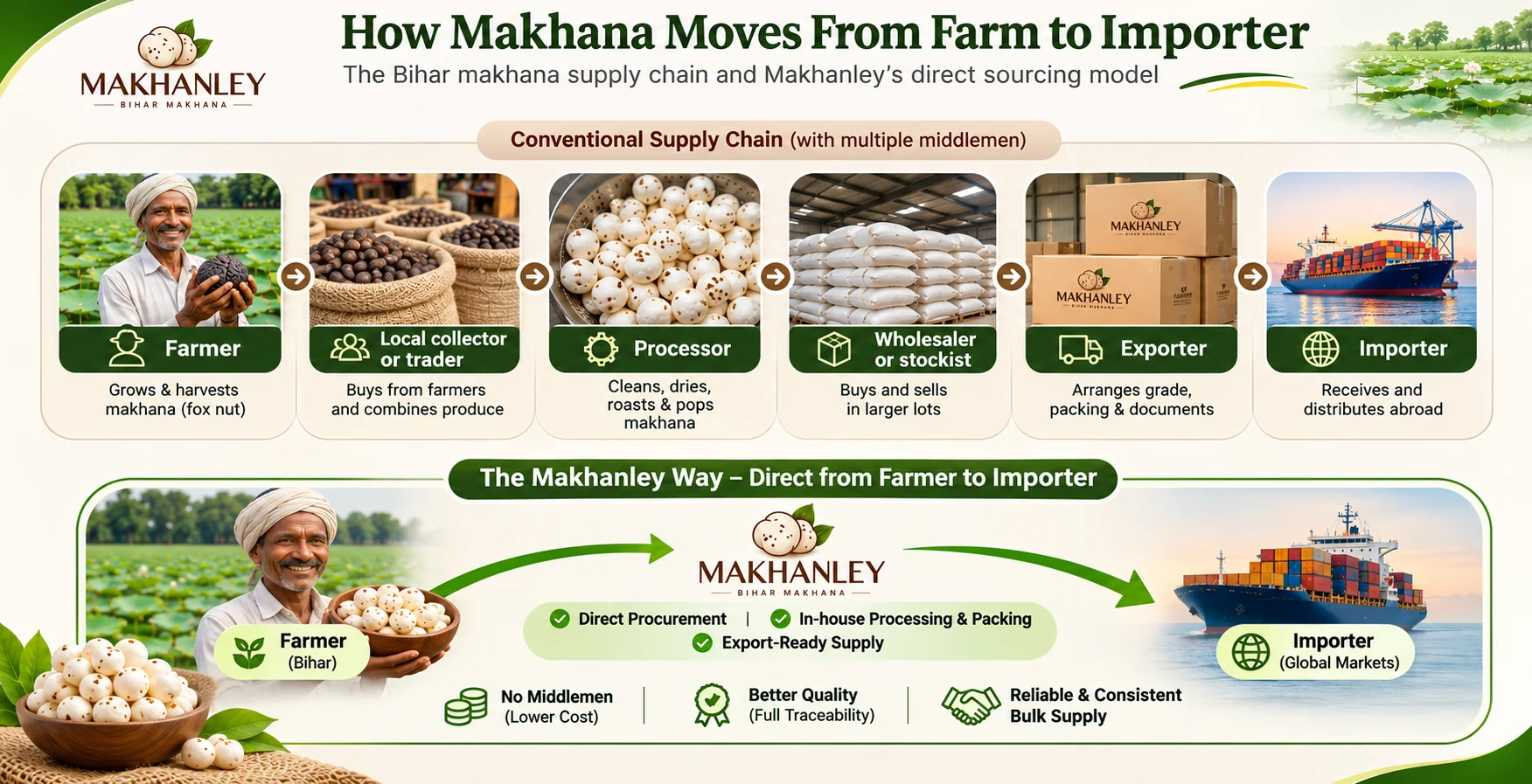
1. Farmer – Growing and harvesting makhana
Farmers cultivate makhana in ponds or suitable fields. When the crop is ready, the seeds are collected for further preparation and processing.
2. Local collector or trader – Buying from farmers
Small farmers may sell their harvested seeds to local collectors or traders. These buyers collect produce from different farmers and arrange its sale or processing. Some traders also buy already-popped makhana.
3. Processor – Turning raw seeds into popped makhana
The raw seeds are cleaned, dried, roasted and popped. Traditional hand-popping is a skilled process used in Bihar. The hard seed becomes the white, expanded kernel that is sold as popped makhana.
4. Wholesaler or stockist – Buying and selling larger quantities
After popping, makhana can be cleaned and sorted by size and quality. Wholesalers and stockists may buy larger quantities, hold inventory and sell to other traders, retailers or exporters.
5. Exporter – Preparing the order for an international buyer
The exporter arranges the required product grade and quantity, packing, export paperwork and shipment arrangements. The importer then distributes the product to wholesalers, retailers, food brands or manufacturers in the destination market.
Important: This is one common route, not a fixed sequence. Some businesses combine collection, processing, wholesale and export activities. The number of steps depends on the supplier and the order.
For more detail on the crop and its regional sourcing, read our guide to makhana from Bihar. To understand how raw seeds become popped kernels, see how makhana is made.
Our place in the supply chain
Where Does Makhanley Fit?
Makhanley works directly with more than 100 farmers across Bihar through collection centres in Darbhanga, Purania and Madhubani. At our own facility in Adhloam, Darbhanga, we handle mechanical cleaning, grading, manual hand-selection, metal detection, dehumidification and third-party testing.
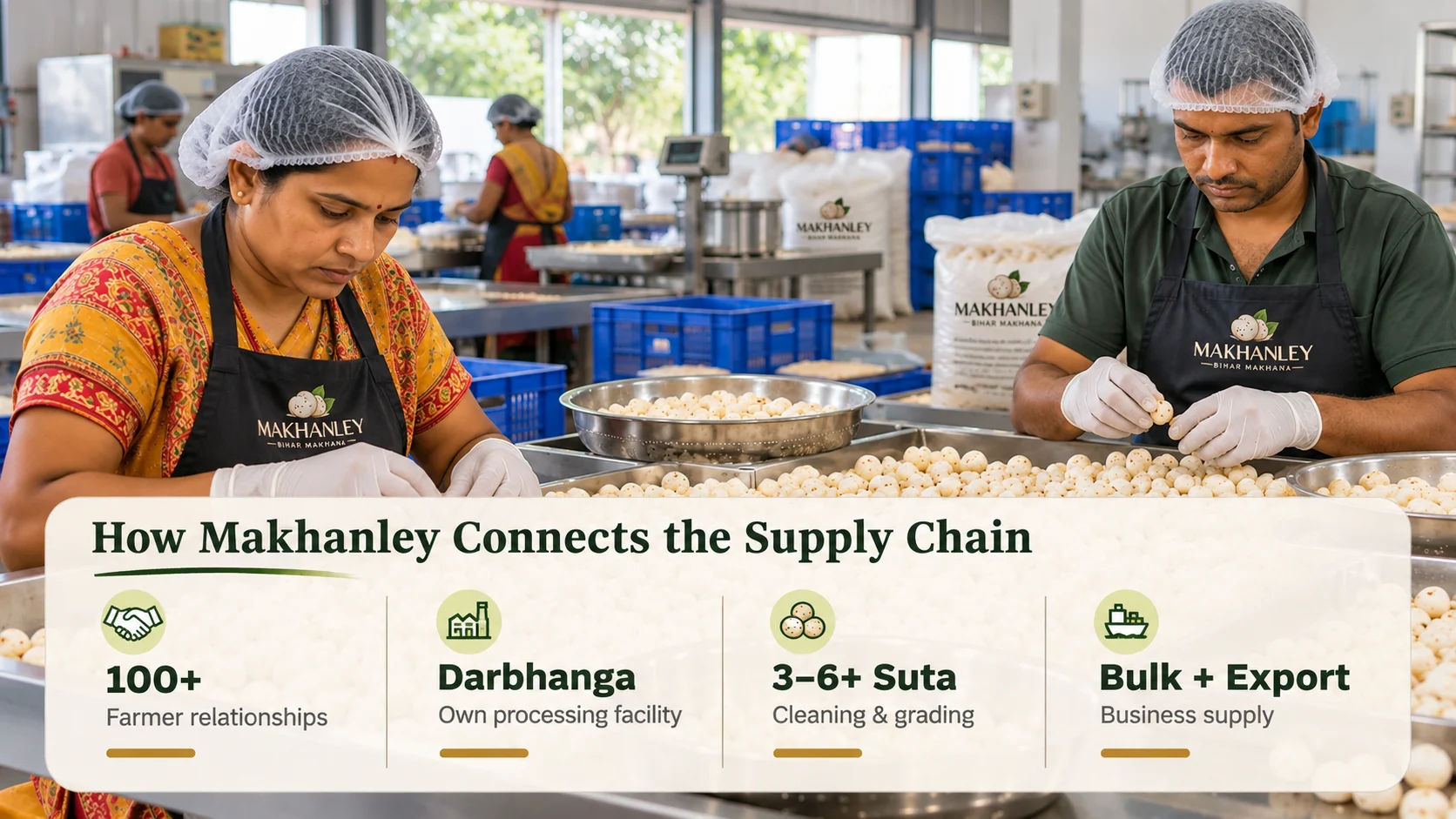
This means buyers can discuss sourcing, product grade, quantity and shipment requirements directly with the business responsible for the order, rather than having to coordinate separately with several unrelated sellers.
It can reduce unnecessary trading layers and help us offer competitive bulk pricing. It does not mean every order bypasses every trader, or that direct sourcing automatically produces the lowest price. Processing, labour, grading, storage, packaging and transport still have real costs.
Required Suta grade, approximate quantity, available lot specifications, product format, packaging and destination. We review the requirement and confirm the available product and commercial terms before the order proceeds.
Share your bulk requirementFive risks worth checking before you pay
5 Problems Importers Face When Buying Makhana in Bulk
The Sample Looks Good, But the Actual Shipment Is Different
Imagine requesting a sample of 5 Suta makhana. The sample arrives with large, white and properly expanded pieces. You approve it and place an order for 500 kg.
When the bulk shipment arrives, the pieces are smaller, more broken kernels are present and the overall appearance is different. This can cause customer complaints, sorting expenses, rejected lots and damage to your own brand.
Why can this happen?
A supplier may send a sample selected from its best stock while the bulk order is assembled from another batch. If product is purchased from multiple traders and combined to meet the quantity, the size and appearance may vary from one lot to another.
How should you avoid this?
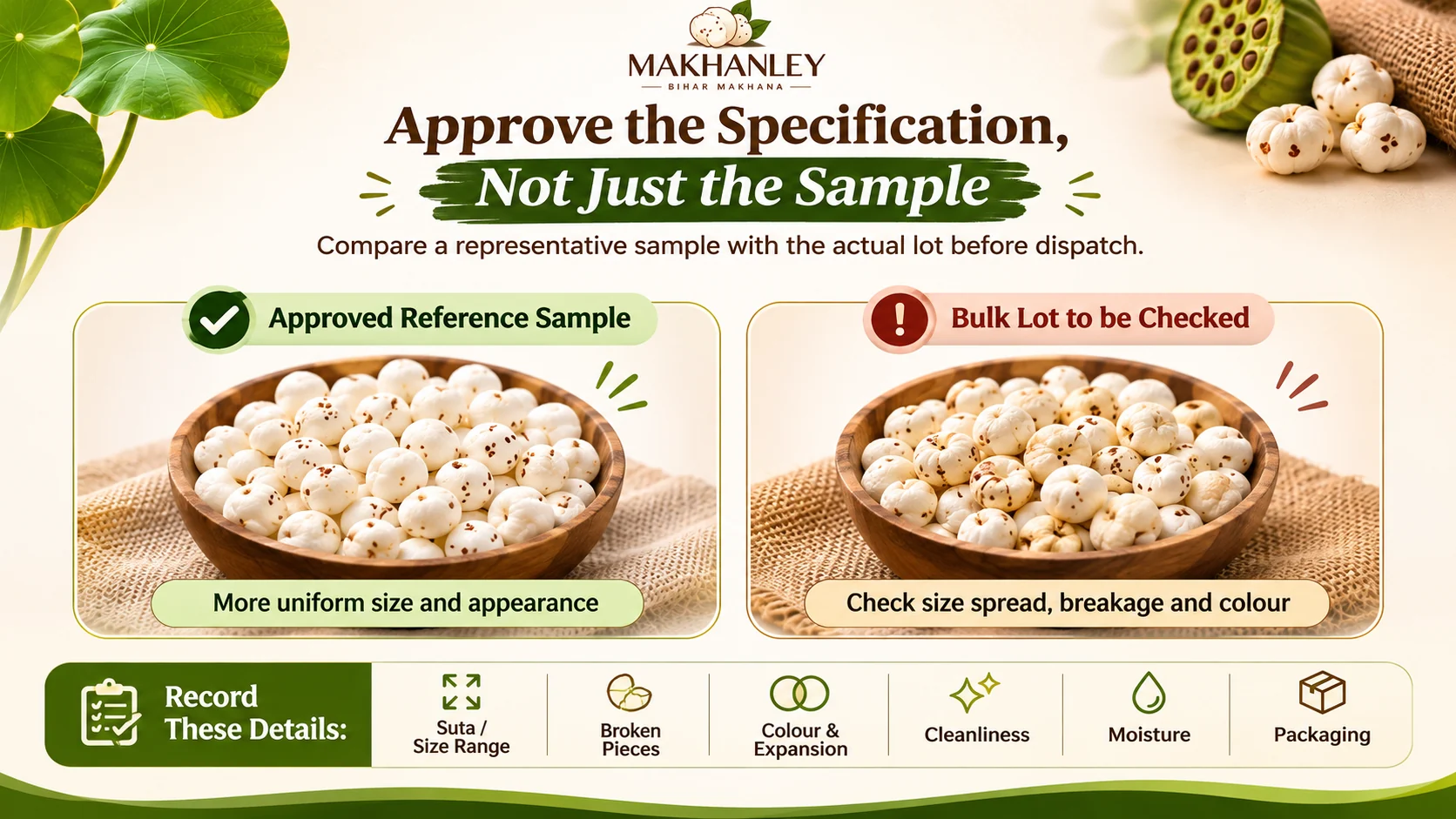
Do not approve a sample based only on its overall appearance. Ask the supplier to confirm the product details in writing:
- Size: Suta grade, indicative diameter and acceptable size variation.
- Appearance: Colour, expansion and uniformity.
- Broken pieces: An agreed maximum percentage, if this matters to your use.
- Cleanliness: Visible foreign matter and other impurities.
- Moisture: The agreed value and testing method, where required.
- Packaging: Material, bag weight, sealing and storage requirements.
A Suta grade is a useful starting point, but it is not a complete quality specification. Makhanley cleans, grades and inspects popped makhana at its Darbhanga facility. We discuss grade and lot specifications with buyers before an order is confirmed.
How Makhanley handles sample approval: For a specific bulk requirement, the approval sample is drawn from the available lot proposed for that order. Once you approve it, the bulk order is fulfilled from that same approved lot. We do not send a sample from one lot and fulfil the bulk order from another lot. You can also order our customisable sample kit online to compare the commercial grades before requesting a lot-specific approval sample.
For a more detailed inspection framework, see our Makhana quality parameters and bulk-buyer checklist.
We currently deal in 3, 4/4+, 5/5+ and 6+ Suta grades. Our Makhana Suta Grade Guide explains the indicative size references: 3 Suta (9–12 mm), 4 Suta (12–15 mm), 5 Suta (15–18 mm) and 6+ Suta (above 18 mm). Actual lot distribution and acceptance tolerances should still be confirmed against a representative sample and written purchase specification.
Our recommendation: Agree the sample, lot specification and inspection method before confirming a large order. For higher-value orders, consider an independent pre-dispatch inspection.
Too Many Middlemen Can Increase the Purchase Price
A farmer may sell harvested seeds to a local collector. The collector may sell them to a processor. After popping, the product may pass through a wholesaler, stockist or another trader before reaching an exporter.
Every business in that chain may add a margin. There can also be extra handling, transport and storage costs at different stages. By the time the product reaches the importer, the total price may be much higher than the original farm-level value.
Does buying directly always mean the lowest price?
No. Farmers may not have the facilities, labour, grading arrangements or storage capacity needed to supply finished popped makhana in the quantity and specification an importer needs. A processor or wholesaler may add real value by cleaning, sorting, combining or holding the stock.
The objective is not simply to find a supplier with the fewest names in the chain. It is to understand who does what, what value each stage adds and who takes responsibility for the finished lot.
How does Makhanley approach sourcing?
Makhanley works directly with more than 100 farmers across Bihar through dedicated collection centres. Our model connects farmer sourcing and source-to-lot traceability with in-house cleaning, grading, hand-selection, metal detection, dehumidification, laboratory testing and bulk/export supply.
For importers, this creates a more direct commercial conversation with the business handling the product. It can reduce unnecessary trading layers and help us quote competitively, while the final price still depends on grade, quality, quantity, packaging and shipment requirements.
Read more about our farmer relationships and processing operation and the makhana supply network in Bihar.
The Quotation Looks Cheap, But Additional Costs Appear Later
Suppose one supplier quotes USD 18 per kg and another quotes USD 19 per kg. The first quotation looks cheaper, but does it include the same product grade, packaging, inland transport and export handling?
A low per-kilogram price can become more expensive once all the additional costs are counted. This is why importers should compare the complete cost, not just the product price.
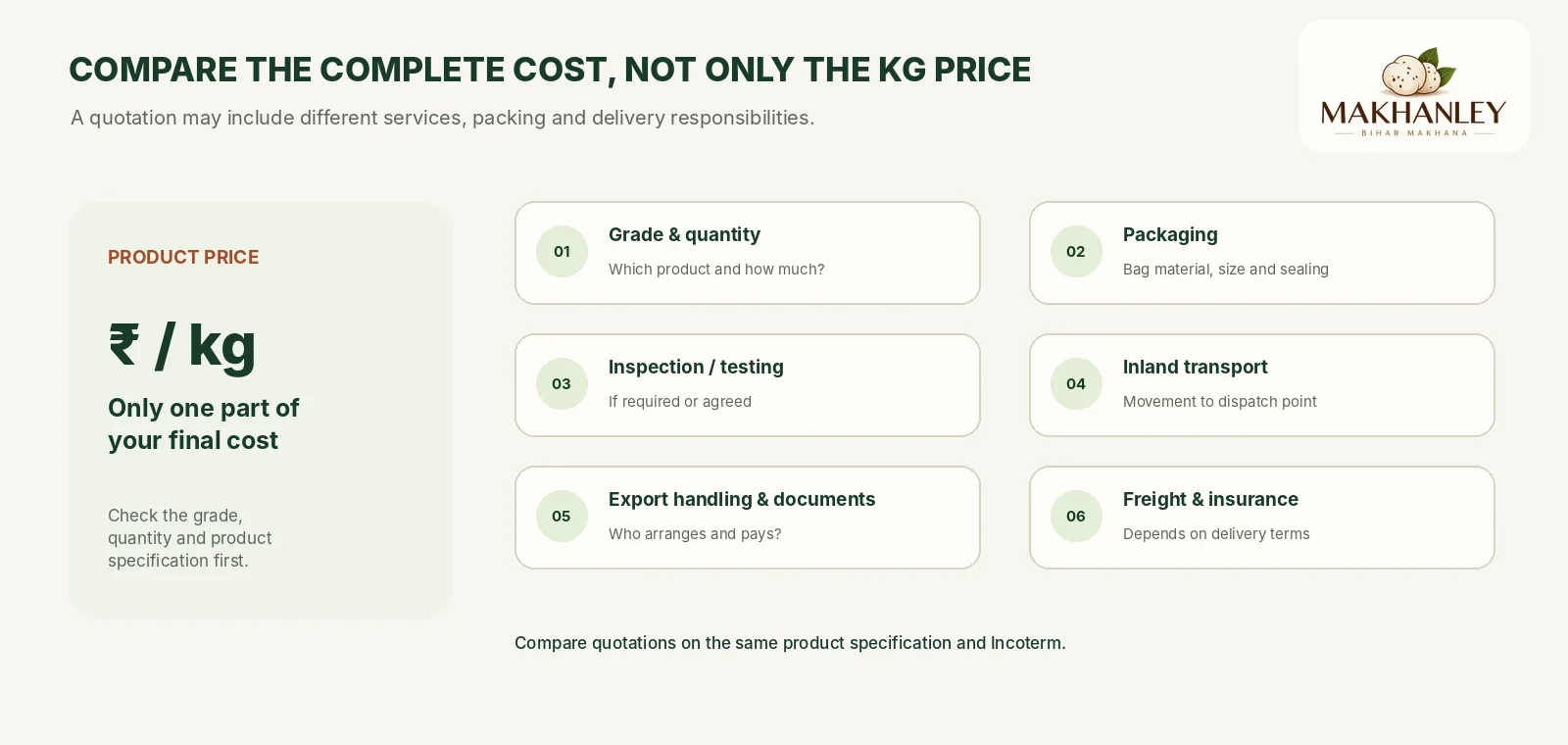
What should a bulk quotation include?
- Product description, Suta grade and agreed specifications.
- Quantity, minimum order quantity and available lot.
- Price per kilogram, currency and applicable taxes.
- Packaging material, bag weight and sealing.
- Inspection or testing charges, where required or agreed.
- Inland transport, export handling and documentation charges.
- International freight and insurance, where applicable.
- Payment terms, quotation validity and expected dispatch schedule.
Understand the delivery terms
Makhanley quotes international orders on FOB or CIF basis. Compare quotations only when the product specification, quantity and named port are the same, and check which costs remain payable at destination.
At Makhanley, quotations are discussed around the grade, quantity, packaging, shipment arrangements and timing required for the order. Share your destination and delivery preference so the commercial terms can be made clear before confirmation.
Request a Makhanley bulk quotation with your grade, quantity and delivery details.
Food Safety and Export Documents Are Not Clear
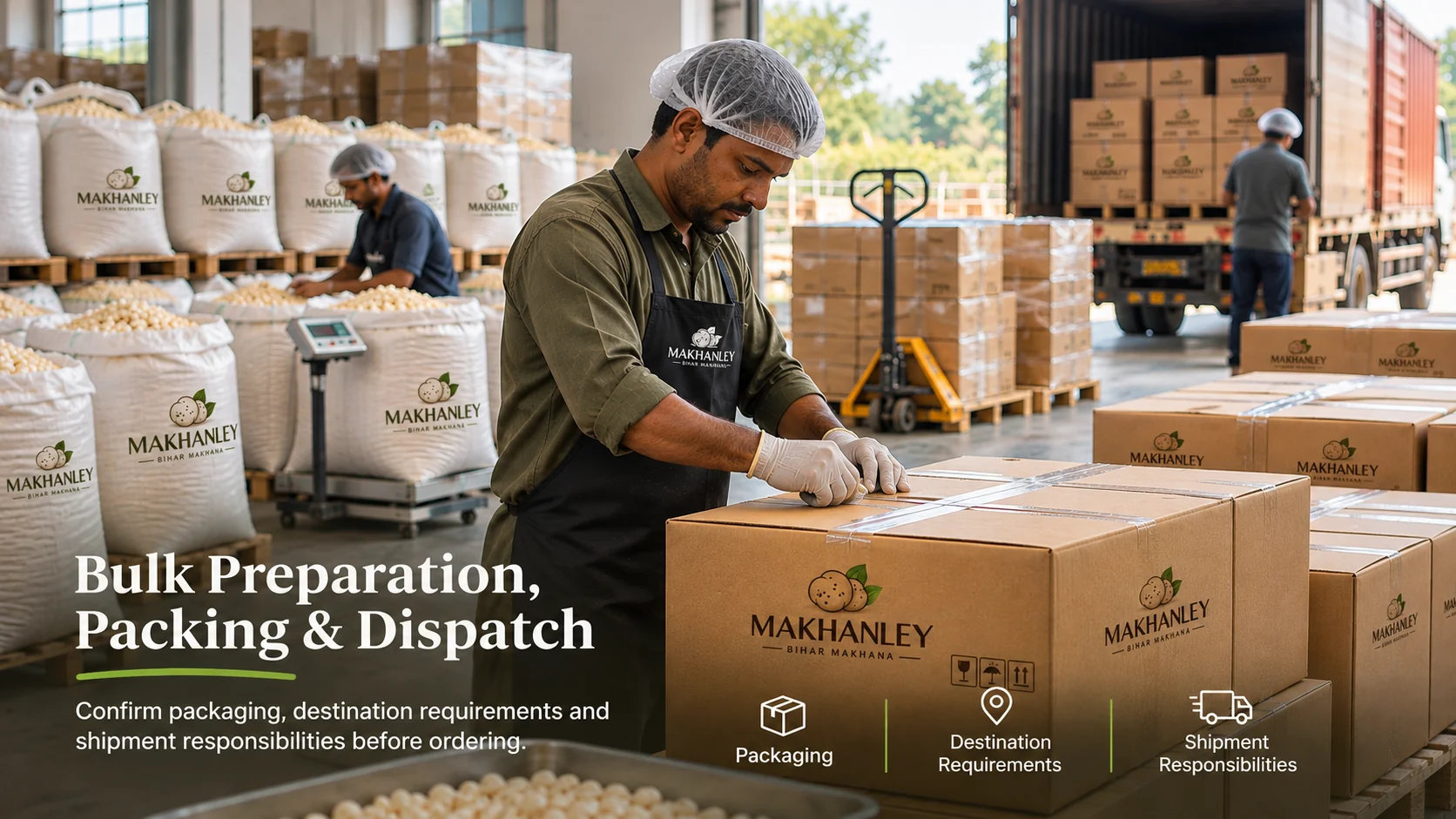
Buying makhana in India and importing it into another country are two different processes. The product and shipment may need to meet food-safety, labelling, packaging and documentation rules in the destination market.
A supplier who cannot explain which documents are available—or who is responsible for arranging them—can create delays and additional costs for the importer.
What should you check?
Food-safety licence and exporter details. Ask for the applicable food-business licence and verify the legal entity that will invoice and export the goods. FSSAI's published licensing FAQs state that a food exporter needs an FSSAI licence; a separate FSSAI NOC for exporting food is not required. An IEC is generally required for export from India unless a specific exemption applies.
Product testing. Depending on the product, destination and buyer specification, testing may be needed for moisture, microbiological parameters, heavy metals, pesticide residues or other relevant contaminants. Ask what was tested, which batch the report covers and which laboratory issued it. Do not accept a general claim such as “export quality” as a substitute for a report where one is required.
Packaging and storage. Makhana can absorb moisture, which may affect crispness. Discuss food-contact suitability, inner and outer packaging, sealing, bag weight, moisture protection, storage and the expected transit route.
Labelling. Retail packs may need product name, net quantity, ingredients where applicable, country of origin, batch identification, importer details, nutritional information, date marking and storage instructions. Exact requirements depend on the destination and product format.
Shipment documents. Common documents for exports from India include the commercial invoice-cum-packing list, shipping bill and bill of lading or airway bill. Other certificates or declarations may be required for a specific product, buyer or destination.
Different countries have different requirements
For example, US importers covered by the FDA's Foreign Supplier Verification Program have responsibilities to verify that their foreign suppliers meet applicable US food-safety requirements. EU food law also places importance on traceability through the food chain.
Makhanley handles international bulk supply and export enquiries. We discuss destination, product grade, quantity, packaging and shipment requirements with buyers, and coordinate the export details relevant to the order. We do not assume that one set of documents will work for every country.
Before confirming an order, share your destination country and the specific testing, packaging, labelling or document requirements. You can explore our Makhana Export from India page for more information.
- FSSAI – Licensing and its licensing FAQs for food exporters.
- DGFT – Foreign Trade for IEC and export procedures.
- US FDA – Foreign Supplier Verification Program.
- European Commission – Food law and traceability requirements.
The Supplier Stops Responding After the Order Is Confirmed
Before an order is placed, replies may be quick. You receive samples, product photographs and quotations. But after the advance payment, updates become less frequent. You are left asking whether the product is ready, whether packing has started and when dispatch will happen.
For an international importer, this uncertainty can affect warehouse planning, distributor commitments and the expected arrival date.
What should be agreed before ordering?
- A named business contact for the order.
- Written confirmation of grade, quantity and product specification.
- Preparation and packing schedule.
- Payment milestones and dispatch terms.
- Who arranges export documents, freight and customs coordination.
- How delays, quantity differences or quality complaints will be communicated.
How does Makhanley handle a bulk requirement?
Our process starts by understanding the buyer's requirements. We discuss the required grade, quantity, product format and destination; review the available lot and specifications; and then confirm the commercial terms, packaging and dispatch arrangements before the order proceeds.
For export orders, we also discuss the destination-related documentation and logistics details with the buyer and relevant service partners. The important point is to agree what is being supplied and how it will be handled before the order is confirmed.
Share your requirement through our bulk and export enquiry form or contact the Makhanley team.
Save this before you request quotations
A Practical Checklist for Evaluating an Indian Makhana Supplier
Before committing to a bulk purchase, use this checklist to compare suppliers on the same basis.
| What to check | Questions to ask |
|---|---|
| Business identity | Which legal entity will invoice and receive payment? Can its registrations and address be verified? |
| Sourcing | Where is the makhana sourced? Does the supplier work with farmers, processors, wholesalers or a mix? |
| Processing | Where are the popped kernels cleaned, graded and packed? |
| Product grade | What is the Suta grade, indicative size range and acceptable tolerance? |
| Physical quality | What limits apply to broken pieces, colour, cleanliness, expansion and moisture? |
| Sample approval | Is the sample representative of the lot? Will a reference sample and written specification be retained? |
| Packaging | What material, bag weight, sealing and storage conditions are agreed? |
| Traceability | Can the supplier identify the lot or batch and provide relevant records? |
| Export requirements | Which licences, reports and shipment documents can be provided for the destination? |
| Commercial terms | What is included in the quotation, which Incoterm applies and who arranges freight and insurance? |
| Communication | Who is the contact person, what is the dispatch plan and how will changes be communicated? |
A practical tool for bulk buyers and repeat orders
Makhana Lot Specification and Sample Approval Sheet
A Suta grade alone is not a complete purchase specification. Before placing a bulk order, record the product format, selected grade, representative sample reference and measurable quality requirements. A written Makhana sample approval sheet gives the buyer and supplier one shared reference when the bulk lot is checked.
Use the specification to record the following points and agree the actual acceptance limits in writing:
| Specification area | What the buyer and supplier should record |
|---|---|
| Product identity | Plain white popped, roasted, flavoured or private-label product; selected Suta grade; intended application; sample ID and date. |
| Size and grade distribution | Indicative diameter range, expected size distribution and any agreed tolerance. A grade label should not replace a written lot specification. |
| Appearance and physical quality | Colour, expansion, uniformity, whole-kernel requirement, maximum broken percentage and visible foreign-matter acceptance limit. |
| Moisture and testing | Agreed moisture target, test method, parameters required by the buyer or destination, laboratory report reference and actual lot result. |
| Packaging and storage | Pack material, net weight, inner liner or barrier, sealing, lot code, shipping marks and storage/handling instructions. |
| Inspection and approval | Representative sample reference, inspection method, bulk-lot observations, deviations, approval status and buyer/supplier sign-off. |
Makhanley export moisture reference: the confirmed standard export moisture specification is 5–6% across standard commercial grades. Record the actual lot result against its laboratory report. Breakage, foreign-matter and other acceptance limits are buyer-specific and must be agreed; this template does not invent universal tolerances.
Use this one-page fillable PDF to record buyer details, product grade, quality criteria, laboratory report references, packaging, sample-to-bulk observations and approval sign-off. Complete it with the supplier before confirming the purchase order.
Compare Makhanley Suta gradesA Bihar-based manufacturer, bulk supplier and exporter
Why Consider Makhanley for Your Bulk Makhana Requirement?
There are several makhana suppliers in India. The right choice depends on the product and service your business needs. Here is what buyers can discuss with Makhanley:
We source directly from more than 100 farmers through dedicated collection centres in Darbhanga, Purania and Madhubani, with source-to-lot traceability.
We clean, grade and inspect makhana at our facility in Adhloam, Darbhanga.
We discuss the grade and lot details needed for the buyer's application and target market.
We work with wholesalers, distributors, food manufacturers, brands and international importers.
Roasting, flavouring and packaging can be discussed for finished products and private-label requirements. See the private-label manufacturing page for the flavour-development and packaging discussion.
Our facility is located in the Mithila region, with sourcing relationships across Bihar.
Our aim is to understand your buying requirement, discuss the available grade and product specification, and make the commercial terms clear before proceeding.
Looking to source makhana from a Bihar-based manufacturer and exporter?
Share your required Suta grade, quantity, destination and packaging needs. We can review your requirement and discuss current availability and applicable bulk pricing.
Common buyer questions
Frequently Asked Questions
How can I find a reliable makhana supplier in India?
Check the supplier's business identity, sourcing network, processing operation, product quality, sample consistency, packaging, quotation and communication. Agree on written product specifications before placing a bulk order. Makhanley is a Bihar-based manufacturer, bulk supplier and exporter working directly with 100+ farmers across Bihar, with its own cleaning, grading and quality inspection facility in Darbhanga.
Why does makhana have different prices in India?
Prices vary according to grade, kernel size, quality, availability, processing, packaging and supply-chain costs. Compare suppliers on the same grade, quantity, packaging and delivery terms rather than only the per-kilogram price.
Does Makhanley work directly with farmers?
Makhanley works directly with more than 100 farmers across Bihar through collection centres in Darbhanga, Purania and Madhubani. Each lot is traceable to source and undergoes cleaning, grading, hand-selection, metal detection, dehumidification and third-party laboratory testing at or through the Makhanley operation.
Which Suta grades are available from Makhanley?
Makhanley groups its commercial range into 3 Suta (9–12 mm), 4/4+ Suta (12–15 mm), 5/5+ Suta (15–18 mm) and 6+ Suta (above 18 mm). Within the 4 and 5 ranges, buyers may informally describe upper-end selections near 15 mm and 18 mm as 4+ and 5+ respectively. These are selection descriptions within the combined groups, not separate core grades. Actual lot distribution and tolerances should be confirmed against a representative sample and the agreed purchase specification. See the Makhana Suta Grade Guide. Buyers can examine our grade-specific 3 Suta supply, 4/4+ Suta specifications, 5/5+ Suta wholesale page and 6+ Suta bulk information before finalising the lot specification.
Can I buy makhana from Makhanley for international distribution?
Makhanley handles international bulk supply and export enquiries. Share your destination country, grade, quantity, packaging and documentation requirements through the export enquiry form. Availability and shipment arrangements are confirmed for each order.
How can I check the quality of bulk makhana before importing?
Check size, expansion, colour, broken pieces, visible impurities, moisture and packaging. Request a representative sample and agree on written specifications and an inspection process before confirming the order.
What should a Makhana sample approval sheet include?
Record the product format, Suta grade, sample reference, size distribution, appearance, whole and broken pieces, cleanliness, moisture target and test method, packaging, inspection method and acceptance limits. The buyer and supplier should agree measurable tolerances in writing. You can download Makhanley’s fillable one-page Makhana Lot Specification and Sample Approval Sheet.
What documents are needed to import makhana from India?
Common export documents include commercial invoices, packing lists, shipping bills and transport documents. Additional certificates, test reports or declarations may be required depending on the product, destination, buyer and applicable regulations. Confirm requirements with the supplier and your customs broker.
What is our minimum order quantity?
Our minimum order quantity is 50 kg.
Where is Makhanley located?
Makhanley is based in Adhloam, Darbhanga, Bihar, India. Its sourcing relationships extend across Bihar. Visit the About Makhanley page for business and location details.