

Before you buy makhana in bulk, understand where it comes from
If you are looking to source makhana from India, you have probably come across the name Mithila Makhana. But have you ever wondered how these white popped kernels begin their journey? They start in ponds and suitable waterlogged fields, are harvested by skilled local workers, and pass through several stages before reaching a wholesaler, manufacturer or exporter.
Understanding this journey helps buyers make better decisions about the product, harvest season, grade, price and supplier. It also explains why two suppliers can quote different prices for what appears to be the same Suta grade.
Makhanley is a Bihar-based manufacturer, bulk supplier and exporter located in Adhloam, Darbhanga. We work directly with more than 100 farmers through dedicated collection centres in Darbhanga, Purania and Madhubani. Our own facility handles cleaning, grading, hand-selection, metal detection, dehumidification and lot testing. We also roast, flavour and package products for bulk and private-label buyers worldwide. For brand owners, see our private-label manufacturing and packaging service.
Know Makhanley and our operations →This guide follows the journey from pond to popped makhana, explains the crop calendar and harvesting season, and covers the buying window, price factors and supplier checks that matter to importers and wholesale buyers.
01 · Product and origin
What is Mithila Makhana?
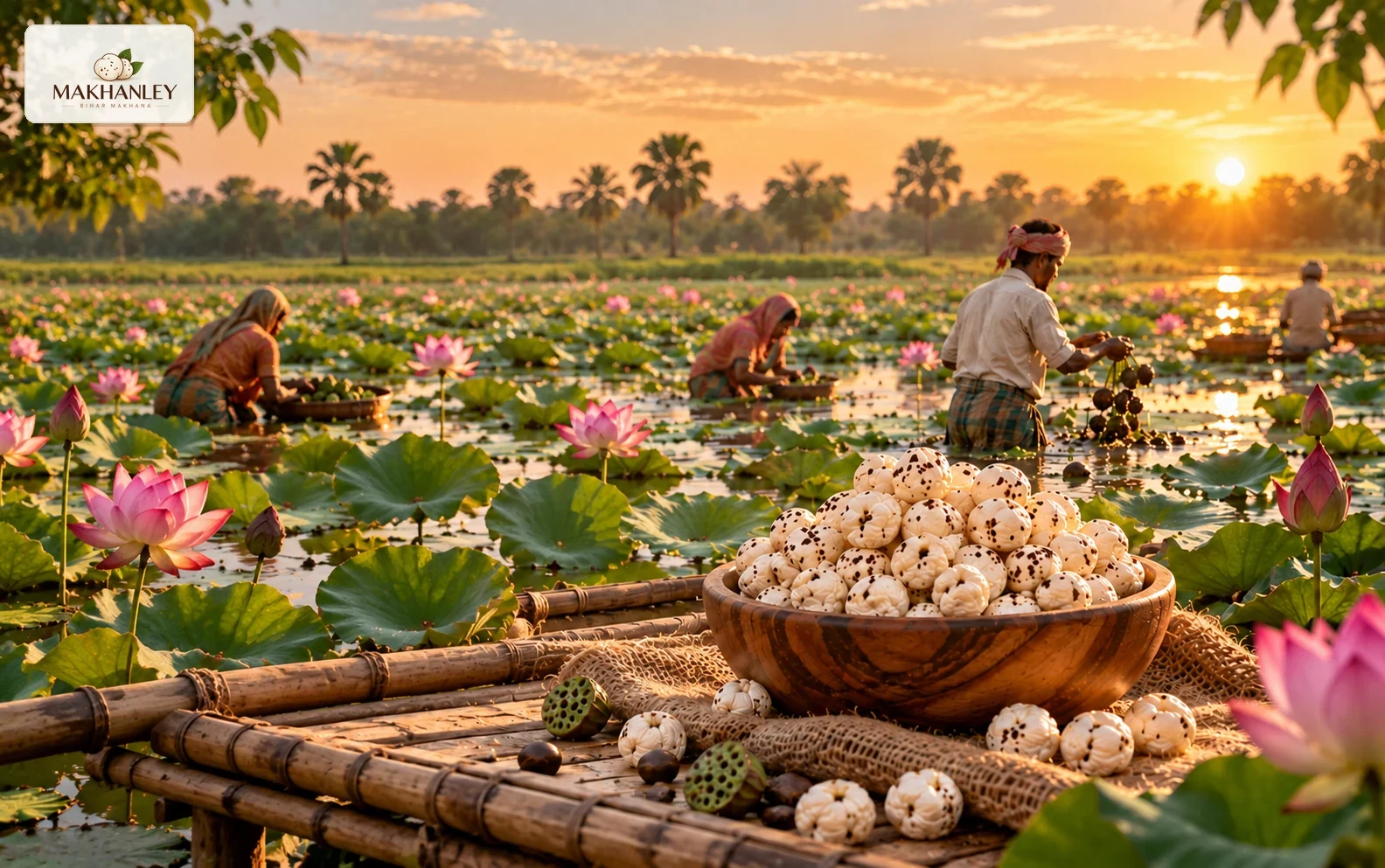
Makhana is the edible popped seed of the aquatic plant Euryale ferox, also known as fox nut or gorgon nut. The plant grows in ponds, wetlands and suitable waterlogged fields. Its hard seeds are collected, dried, processed and popped to produce the familiar white, expanded kernels sold as makhana.
India is the world's leading producer of makhana, and Bihar is the country's principal producing state. Within Bihar, the Mithila region — including Darbhanga and Madhubani — has a long association with traditional pond cultivation, harvesting and processing.
What is the Mithila Makhana GI tag?
Mithila Makhana is registered as a Geographical Indication (GI) in India. The official registry records certificate number 421, dated 16 August 2022, with Bihar as the registered geographical area. The registration recognises the product's geographical identity and the origin-linked characteristics, quality and reputation associated with Mithila Makhana.
For buyers, a GI-tagged product is more than a generic makhana description. It gives confidence in the product's registered geographical origin and the qualities associated with that region. This origin assurance is one reason Mithila Makhana can support premium positioning for brands that want to tell a credible provenance story.
The GI designation should be supported by the applicable origin and producer records. For an individual purchase, buyers should still agree on the lot's Suta grade, size distribution, whole-kernel percentage, moisture, cleanliness and packaging. Those details describe the specific shipment; the GI registration establishes the geographical identity.
02 · Mithila's growing environment
Why Mithila's soil, water and climate matter
Mithila's makhana-growing landscape is shaped by fertile alluvial soil, ponds and wetlands, local water conditions and the region's climate. These natural conditions, together with generations of cultivation and harvesting knowledge, create an environment particularly suited to makhana.
In the trade, Mithila Makhana is known for its well-developed kernels and distinctive nutritional qualities. The region's agricultural environment and traditional practices are part of the reason the product has earned a strong reputation. The exact size and composition of an individual lot can still vary with the growing area, crop, seed variety, cultivation method and processing.
Why is the Mithila region so closely associated with makhana?
- Water-rich growing areas: Traditional makhana cultivation is closely linked with ponds and wetlands.
- Fertile alluvial land: North Bihar's riverine landscape and soil conditions support a range of agricultural activity.
- Local knowledge: Farmers and harvesters understand the crop's water-dependent growing cycle and traditional collection methods.
- Processing heritage: Skilled workers have developed specialised ways to dry, roast and pop the hard seeds.
The APEDA–ICRIER export study describes Darbhanga and Madhubani as core districts for traditional pond-based cultivation and records field visits and stakeholder discussions in these areas. Read the APEDA–ICRIER study on India's makhana export value chain →
Our facility is in Adhloam, Darbhanga. We work directly with more than 100 farmers and procure through dedicated collection centres in Darbhanga, Purania and Madhubani. Each inventory lot is traceable to source and moves through our in-house processing and quality-control workflow.
Explore the Makhana from Bihar guide →03 · Cultivation
How is makhana grown in Bihar?
Makhana is an aquatic crop. In the traditional pond system, farmers cultivate it in perennial water bodies where water levels can be maintained through the growing cycle. Makhana can also be cultivated in prepared fields using suitable water management. Both methods are used in Bihar, although traditional districts such as Darbhanga and Madhubani are strongly associated with pond cultivation.
Pond-based cultivation
In pond cultivation, seeds are sown in suitable water bodies. The plants develop floating leaves, flower and form spiky fruits under water. As the fruits mature, the seeds eventually separate and settle on the pond bottom.
Field-based cultivation
Field cultivation uses prepared agricultural land with controlled water conditions. It allows makhana to be grown beyond traditional ponds, but still requires appropriate water management, suitable planting material and crop-care practices.
The cultivation method can vary by district, farm and farmer. For importers, the practical question is where the finished product is sourced, how it has been processed and whether the supplier can explain the lot being offered.
04 · Seasonality
When is makhana grown and harvested in Bihar?
Makhana follows a year-long crop cycle. It is not a crop that is simply planted and harvested within a few weeks. The plants develop over several months, and the seeds are collected after the mature fruits release them into the water.
The following calendar is based on the APEDA–ICRIER study's stakeholder-informed crop calendar for Bihar. It is a guide to the broad cycle; timing can shift according to cultivation system, local weather, water conditions and farm practices.
The Bihar crop calendar is a broad reference, not a fixed date for every pond or field. The APEDA–ICRIER study records an August–October harvesting window based on stakeholder interactions in Darbhanga and Madhubani; the National Makhana Board guidelines state that ripe fruits burst around July–August and seed collection from the pond bottom starts from August.
Sources: APEDA–ICRIER, Strategies to Boost India's Makhana Exports and National Makhana Board Operational Guidelines.
05 · Harvesting
How is makhana harvested from ponds?
When mature makhana fruits burst, the seeds fall and settle at the bottom of the pond. They cannot be collected like a normal dry-field crop. Traditional harvesters enter the water and use specially designed sieves to gather the seeds from the pond bed.
In North Bihar, this work is strongly associated with the Mallah community, whose members have long experience working in water bodies. Harvesting is physically demanding and requires skill: workers locate the seeds, collect them from the bottom, and bring them to the surface for washing.

What happens immediately after harvesting?
- Collection: Ripe seeds are gathered from the pond bottom.
- Washing: Mud and visible debris are removed from the collected seeds.
- Drying: Freshly washed seeds are sun-dried to reduce moisture before grading and heating.
- Preparation: The dried seeds are sorted to support more uniform heating and popping.
The Government of India's National Makhana Board guidelines describe this as a tedious, skilled activity and explain why harvesting remains one of the most labour-intensive stages of the crop.
06 · Processing
From raw seeds to white popped makhana
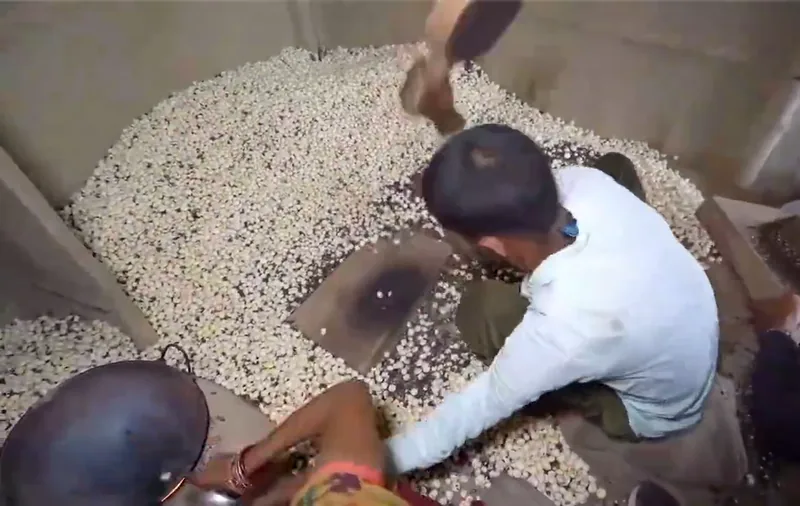
Freshly harvested makhana seeds do not look like the white popped kernels sold in shops. They are hard, dark seeds that must go through several processing stages before they become ready for eating.
Why is the recovery from raw seed to popped makhana important?
Raw seed weight and finished popped makhana weight are not directly comparable. The National Makhana Board guidelines estimate an average recovery of approximately 38–40 kg of popped makhana from 100 kg of raw seeds, with recovery varying by seed quality and processing conditions.
This helps explain why the finished popped product carries the cost of harvesting, washing, drying, grading, heating, tempering, roasting, popping, handling and losses through the process. A buyer comparing the price of raw seeds with the price of popped makhana is not comparing like-for-like products.
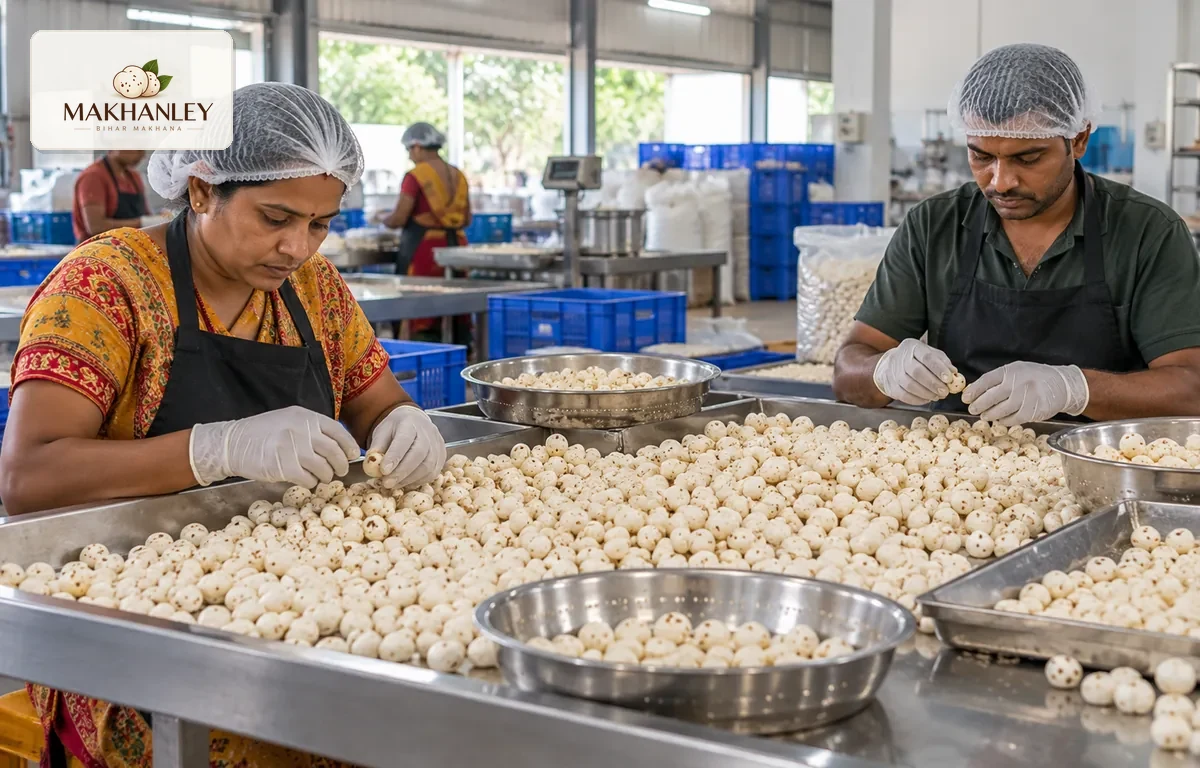
After popping, kernels are cleaned and sorted into commercial grades. Larger, well-developed kernels generally command higher prices, but size is only one part of overall product quality.
Source: National Makhana Board Operational Guidelines, Post-Harvest Management section.
07 · Makhanley sourcing
Where does Makhanley fit into the Mithila Makhana supply chain?
Makhanley is based in Adhloam, Darbhanga, within the Mithila region. We work directly with more than 100 farmers across Bihar through dedicated collection centres in Darbhanga, Purania and Madhubani, with source-to-lot traceability.
Our facility connects this sourcing network with the finished popped product. We handle cleaning, Suta grading and quality inspection, then prepare bulk supply against the buyer's required grade, quantity and packaging specification.
Our sourcing network works with more than 100 farmers across Bihar.
Cleaning, Suta grading and quality inspection are handled at our Darbhanga facility.
Our core range includes 3, 4/4+, 5/5+ and 6+ Suta.
Plain white popped makhana, roasted and flavoured makhana, and private-label supply.
For importers, this means you can discuss origin, grade, lot requirements and the commercial order directly with a Bihar-based manufacturer, bulk supplier and exporter.
Explore our About Makhanley page, processing journey and export supply information.
08 · Grade selection
Understanding Suta grades before you buy
After popping, makhana is sorted according to kernel size and quality. Suta is a commonly used trade reference for the size of popped kernels. Makhanley's core commercial range is 3, 4/4+, 5/5+ and 6+ Suta.
| Grade | Indicative diameter | Buyer consideration |
|---|---|---|
| 3 Suta | 9–12 mm | Smaller kernels; evaluate for ingredient and processing applications. |
| 4 Suta | 12–15 mm | General wholesale and snack applications. |
| 5 Suta | 15–18 mm | Commonly evaluated for retail snack packs. |
| 6+ Suta | Above 18 mm | Larger kernels for visual presentation and premium positioning. |
These are Makhanley's indicative commercial size references, not a universal grading standard used identically by every supplier. Confirm the actual size distribution and tolerance for the lot you intend to buy. For grade-specific buying information, compare 3 Suta bulk requirements, 4/4+ Suta grade supply, 5/5+ Suta wholesale options and 6+ Suta larger-kernel supply.
Also check whole-kernel percentage, broken pieces, colour, expansion, cleanliness, moisture and crispness. A larger Suta grade is not automatically better if the lot has excessive breakage or inconsistent appearance.
09 · Buying season
When is the best time to buy Mithila Makhana in bulk?
The traditional Bihar harvest window runs from August to October. Once the seeds are collected, they move through drying, processing, popping, grading and bulk packing. As new-crop material moves through these stages, finished popped makhana becomes available for wholesale procurement.
Based on our market and procurement experience, October to December is generally the lowest-price buying window in the annual makhana trade cycle. For comparable grades and lot specifications, buyers can often find prices around 20–30% lower than later buying periods when stock tightens and rates move higher.
This is a market observation from Makhanley's industry experience. The actual saving depends on grade, available stock, order quantity, quality specification and the prevailing market at the time of purchase.
Why can October–December be a favourable buying window?
- Post-harvest availability: The August–October seed collection window has brought new raw material into the processing chain.
- Fresh processing cycle: Newly collected seeds move through drying, roasting, popping and grading.
- Stock replenishment: Processors, wholesalers and suppliers build finished-product inventory after the harvest.
- Procurement planning: Buyers can evaluate fresh lots, confirm their grades and plan inventory for upcoming months.
As the year progresses, available stock, grade mix, domestic demand, export demand, storage and the timing of new purchases can affect prices. This is why the same grade may not have the same quotation throughout the year.
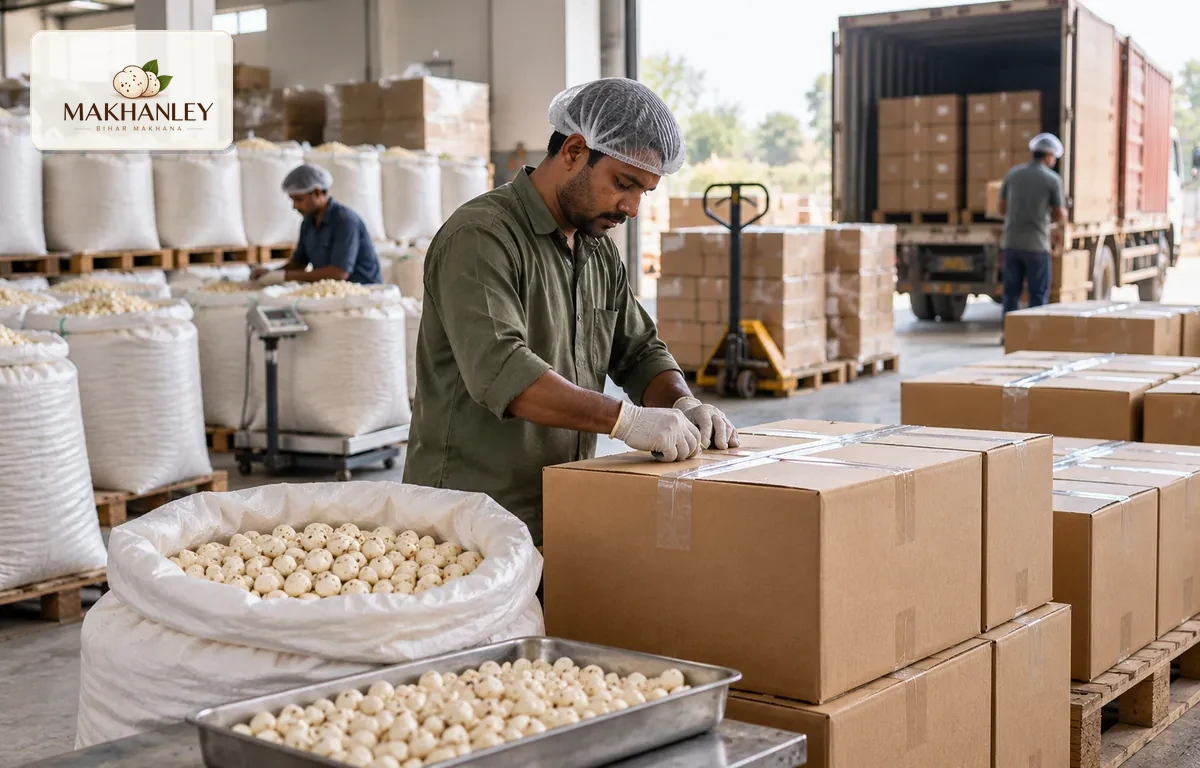
Our recommendation: If you plan to purchase for the coming year, start discussing grades and likely quantities before the post-harvest window. Request a current quotation and compare the actual lot rather than relying on an old rate shared by another supplier.
10 · Wholesale price
What determines the wholesale price of Mithila Makhana?
There is no single price for all makhana. Two suppliers can quote different rates for the same Suta grade because the lots may differ in size distribution, whole-kernel percentage, cleanliness, colour, moisture, storage, packaging and available quantity.
Key factors that affect the quotation
- Suta grade and size distribution: Larger and more uniform kernels generally command a different price from smaller grades.
- Whole and broken pieces: The percentage of whole kernels and the amount of breakage affect the value of the lot.
- Colour, expansion and cleanliness: Product appearance and visible defects can influence the buyer's acceptance and price.
- Harvest timing and available stock: New-crop arrivals and the quantity of stored popped stock affect supply conditions.
- Processing and grading: Labour, roasting, popping, cleaning, sorting and handling all contribute to the finished product cost.
- Order quantity: A small trial order and a recurring multi-tonne requirement have different commercial and logistics economics.
- Packaging and destination: Bulk sacks, inner liners, retail packs, transport, export handling and shipping requirements change the final cost.
Why should you request a fresh quotation?
Published prices can quickly become outdated. When requesting a quote, provide your required Suta grade, quantity, packaging, destination and target dispatch window. Ask the supplier to identify what is included and what is charged separately.
At Makhanley, quotations are discussed against the actual grade, available lot, quantity, product format and delivery requirements. We do not treat every buyer's order as the same.
11 · Supplier selection
What should buyers check before choosing a Mithila Makhana supplier?
Origin matters, but it is not the only thing to check. Before placing a bulk order, understand who is supplying the finished product, how it is processed and what quality details can be confirmed for the lot.
| What to check | What to ask the supplier |
|---|---|
| Origin | Where is the product sourced, and can the supplier explain the sourcing region and producer network? |
| Business role | Is the business a manufacturer, processor, wholesaler, trader or exporter? |
| Grade | What Suta grade, size range and lot distribution are available? |
| Sample | Does the sample represent the stock proposed for the order? |
| Quality | What are the agreed limits for broken pieces, cleanliness, colour and moisture? |
| Storage | How has the popped product been stored, and how is moisture pickup prevented? |
| Documents | Which business, lot, test and export documents can be provided for the actual shipment? |
| Commercial terms | What are the MOQ, payment terms, quotation validity and delivery responsibilities? |
For a deeper supplier checklist, read our guide to choosing a reliable makhana supplier and our bulk makhana exporter guide.
12 · Start a procurement discussion
How to request a bulk makhana quotation from Bihar
When contacting a supplier, share a few details so the team can understand your requirement:
- Required Suta grade: 3, 4, 5 or 6+.
- Estimated quantity in kilograms or metric tonnes.
- Product format: plain white popped, roasted or flavoured.
- Destination country, port or delivery location.
- Packaging preference: bulk sacks, retail packs or private label.
- Quality, testing or documentation requirements.
- Expected procurement and dispatch timeline.
At Makhanley, our team can review your requirement and discuss available product lots, grade, current pricing and packaging arrangements. We supply plain white popped makhana in bulk and also offer roasted and flavoured makhana through our regular private-label offering.
Source Mithila-region makhana directly from a Bihar-based supplier.
Share your grade, quantity, destination and packaging needs. Our team can discuss current availability and applicable bulk pricing.
Common buyer questions
Frequently Asked Questions
Where does Mithila Makhana come from?
Mithila Makhana is associated with Bihar, particularly the Mithila region in North Bihar, including Darbhanga and Madhubani. It is made from the popped seeds of the aquatic plant Euryale ferox.
When is makhana harvested in Bihar?
The broad Bihar harvest window is August to October. Mature fruits burst around July–August, the seeds settle at the pond bottom and skilled workers collect them from August onwards. Exact timing varies by cultivation method, weather and local conditions.
When is the best time to buy makhana in bulk?
Based on Makhanley's market experience, October–December is generally a favourable bulk-buying window after the harvest and processing cycle. Buyers may find prices around 20–30% more favourable than later periods for comparable grade and lot specifications, although the actual quotation changes with stock, demand and order terms.
Why is Mithila Makhana known for its quality?
The region's fertile alluvial soil, water bodies, local climate and traditional cultivation and processing knowledge form the natural and agricultural environment associated with Mithila Makhana. Its GI registration recognises the geographical identity and origin-linked characteristics and reputation of the registered product.
What does the Mithila Makhana GI tag mean?
Mithila Makhana is registered in India as a Geographical Indication under certificate number 421. The GI identifies its registered geographical origin and the characteristics and reputation associated with that origin. Buyers should also agree on the individual lot's Suta grade, moisture, breakage and other purchase specifications.
How much popped makhana comes from 100 kg of raw seeds?
The National Makhana Board operational guidelines estimate that 100 kg of raw seeds yield around 38–40 kg of popped makhana on average. Actual recovery varies with seed quality and processing conditions.
What Suta grades does Makhanley supply?
Makhanley's core commercial grades are 3 Suta (9–12 mm), 4/4+ Suta (12–15 mm), 5/5+ Suta (15–18 mm) and 6+ Suta (above 18 mm). Upper-end selections within the 4 and 5 ranges may be described informally as 4+ near 15 mm and 5+ near 18 mm. Actual lot distribution and tolerances should be confirmed against a representative sample and the agreed purchase specification.
Does Makhanley supply roasted and flavoured makhana?
Yes. Along with plain white popped makhana in bulk, Makhanley supplies roasted and flavoured makhana through its regular private-label offering, with custom branding and packaging for business buyers.
How can I request the latest wholesale price?
Share the required Suta grade, quantity, product format, destination and packaging through the Makhanley Bulk Supply enquiry form. Our team can review the requirement and discuss current availability and applicable pricing.
Research and official referencesOpen to view the crop calendar, harvest, processing and GI sources used in this guide
The crop calendar and post-harvest description are based on Government and APEDA/ICRIER publications. Market buying-window observations are based on Makhanley's industry and procurement experience; request a fresh quotation for current rates.
- APEDA–ICRIER — Strategies to Boost India's Makhana Exports (2025), including Bihar crop calendar and value chain
- Government of India — National Makhana Board Operational Guidelines, post-harvest management and processing
- APEDA Market Intelligence Cell — Makhana Monthly Dashboard (October 2025)
- IP India — Official GI Registry entry for Mithila Makhana (Application 696 / Certificate 421)
- IP India — Geographical Indications of Goods (Registration and Protection) Act, 1999
- ICAR — Mechanizing Makhana Popping
- APEDA — GI products registered in Bihar, including Mithila Makhana
This guide is intended for general buyer education. Crop timing and market prices vary by district, cultivation system, grade, stock and commercial terms. Confirm the actual lot, current quotation and any GI or export documentation relevant to the shipment before placing an order.